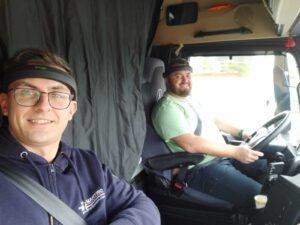
Fatigue at the wheel does not always announce itself. A driver can feel alert while their attention is already fading. At Oraigo we use EEG technology to read brain signals and help drivers recognise the risk of a microsleep before it becomes an accident.
We do not want to replace the person at the wheel, nor to surveil them. We want to give them one more piece of information about themselves, precisely when personal perception is not enough.
Key takeaways
- Fatigue is an important factor in 10–20% of road accidents in Europe.
- Tiredness is often invisible to the person experiencing it: feeling fine is not the same as being alert.
- In our on-road research (101 sessions, no alerts active) we detected 132 events, peaking between 13:30 and 14:00.
- EEG reads the brain, not the face: no cameras, anonymous data, and the decision stays with the driver.
The truck measures everything, the person almost nothing
Location, fuel consumption, maintenance, tyre pressure, ADAS: the modern truck reports its own status continuously. European rules require it too. The General Safety Regulation mandates driver drowsiness and attention warning (DDAW) on new vehicles, defined by Delegated Regulation (EU) 2021/1341 and mandatory for new vehicle types since 6 July 2022.
📘 Read more: everything on the regulatory requirements in our GSR II and DDAW page.
The truck tells us when a tyre has a problem. Our question is simple: can we also give the person who drives more information about themselves? We started with fatigue and microsleeps, because this is where risk often grows without visible signals.
Fatigue at the wheel: a risk with many causes
According to the European Commission’s ERSO summary, fatigue is an important factor in 10–20% of road accidents. For commercial transport, the ETSC estimates around 20% of collisions. And it never comes down to a single factor:
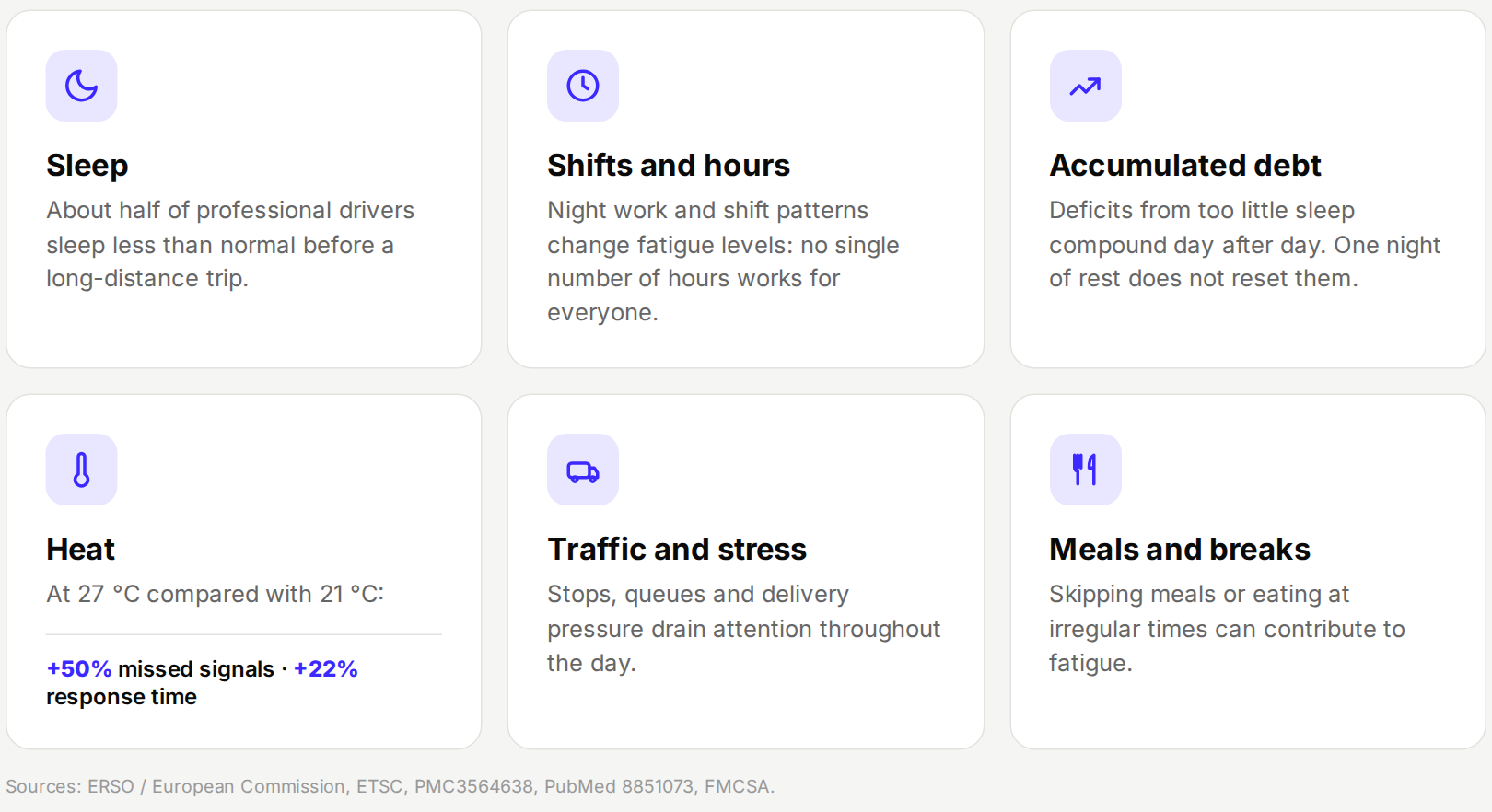
The evidence behind these factors: chronic sleep restriction, heat and driver performance and FMCSA guidance on meals and breaks.
This is why two drivers can live through the same working day in completely different ways. The driving time rules in Regulation (EC) No 561/2006 remain essential, but they cannot see what is happening inside the driver’s head.
The perception gap: feeling fine while attention is already fading
Sometimes we know we slept badly and feel our attention slipping. Other times we feel fine, yet some signals already point to a decline. Even professionals get caught out: “I’ve felt like this many times, I can keep going.”
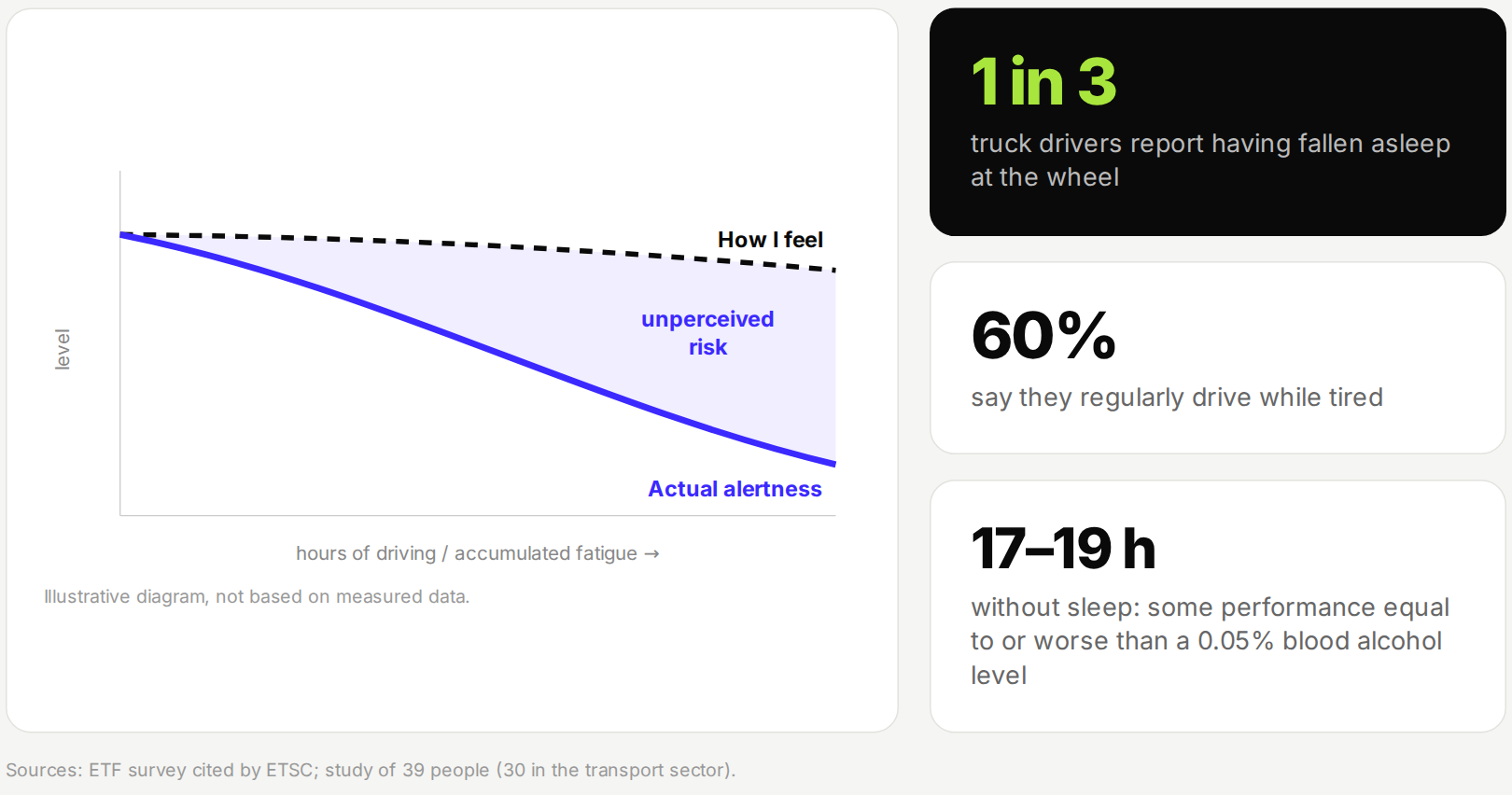
Research confirms it. In the chronic sleep restriction study, participants were largely unaware of their growing deficits. Their drowsiness ratings did not follow the actual decline in performance.
This is why drivers need objective data alongside their own sense of how they feel.
How the Oraigo uses EEG Technology to Prevent Fatigue
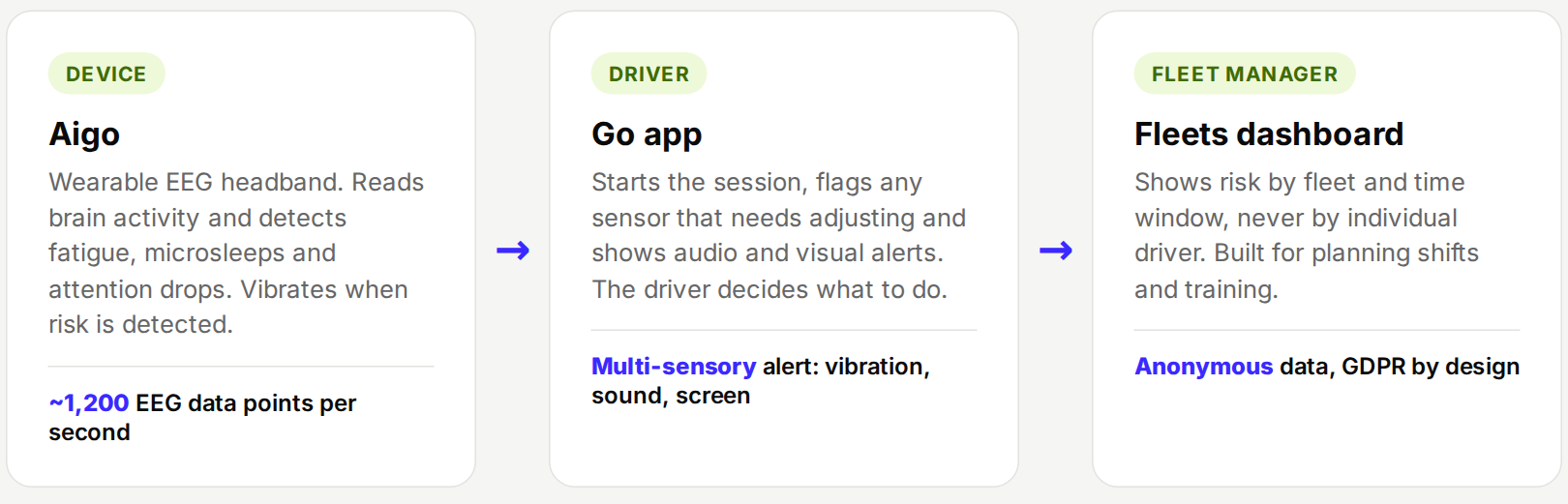
Aigo reads the signals, the Go app alerts the driver and the Fleets dashboard gives the fleet manager an aggregated view. The full flow is explained on the How it works page.
How to wear it, in 4 steps
- Widen the headband using the rear flaps and put it on.
- Tighten it: it should sit about one finger above the eyebrows and lightly touch the ears.
- Switch the device on with the button, log in to Go and start the session.
- If a sensor needs adjusting, the app flags it: just rotate it and press.
When fatigue is detected, the driver feels a vibration in the headband and receives audio and visual alerts in the app. The warning is multi-sensory, so it gets through even when attention is already reduced.
Why EEG and not cameras
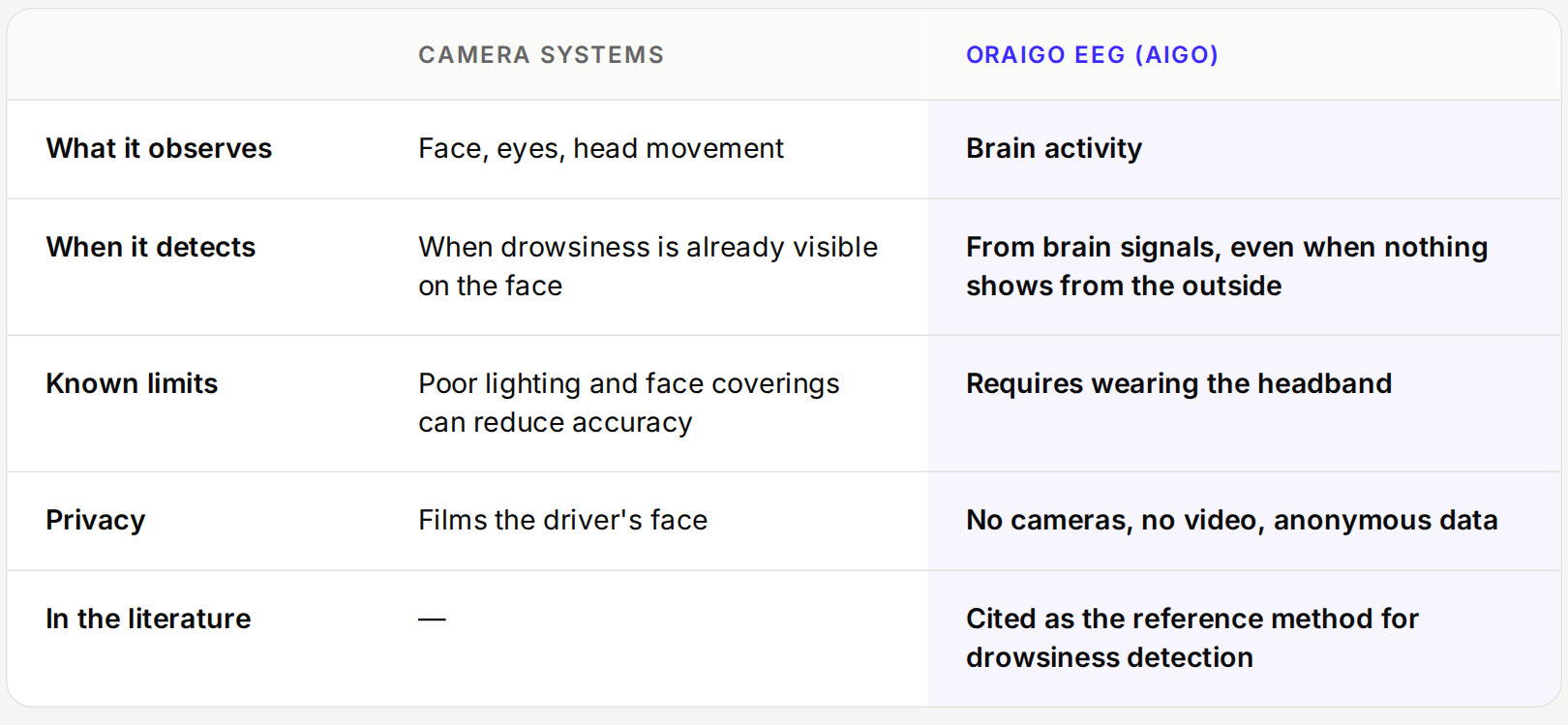
📘 Read more: the full comparison on our EEG vs cameras page.
Empowering drivers, not controlling them
Technology should not replace the driver’s judgement: it should add information to it.
- The decision stays with the driver. The alert says “pay attention”. The driver then chooses whether to focus harder, take a break or stop to rest.
- Privacy without cameras. The system records no video and follows GDPR by design: data is anonymous and linked to the company, not the individual. A tool that does not film is seen as a safety aid, not an eye pointed at you.
- From alert to awareness. Every alert is feedback. Over time drivers learn when it happens to them and start recognising the signals on their own.
Our on-road research: what the data says
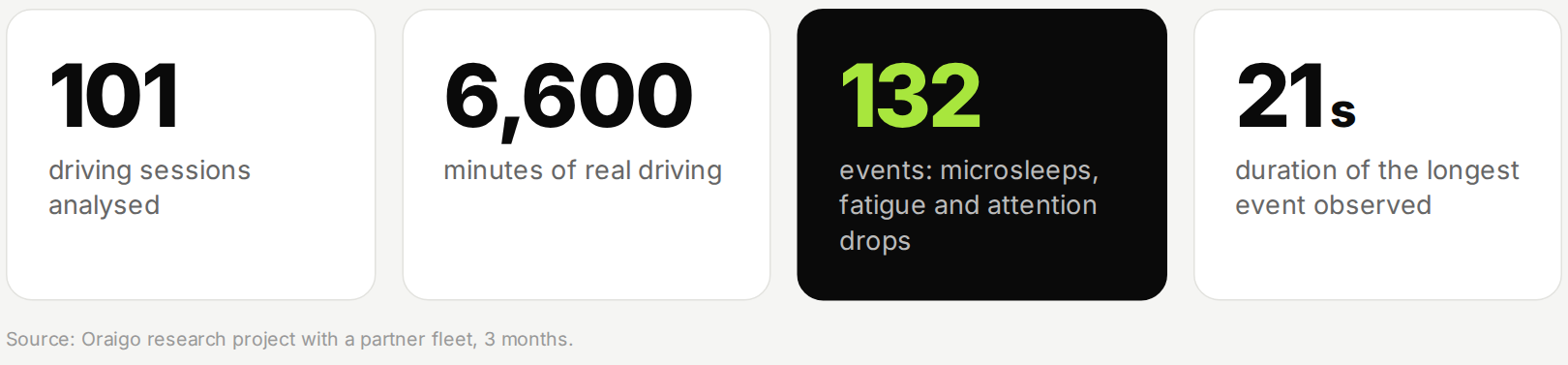
We observed fatigue during real work, on the road and without simulators, together with a partner fleet. The project covered two groups of drivers:
| Last-mile | Long-haul | |
|---|---|---|
| Duration | 1.5 months | 1.5 months |
| Type of driving | Frequent stops and urban traffic | Hours of continuous driving |
| Read more | Last-mile | Road haulage |
🔬 A note on method: no alerts were active during the project. This was a measurement-only phase, showing what happens when drivers receive no additional information. It gives us a clean baseline to compare against in the next phase, with alerts switched on.
Risk concentrates in a few sessions
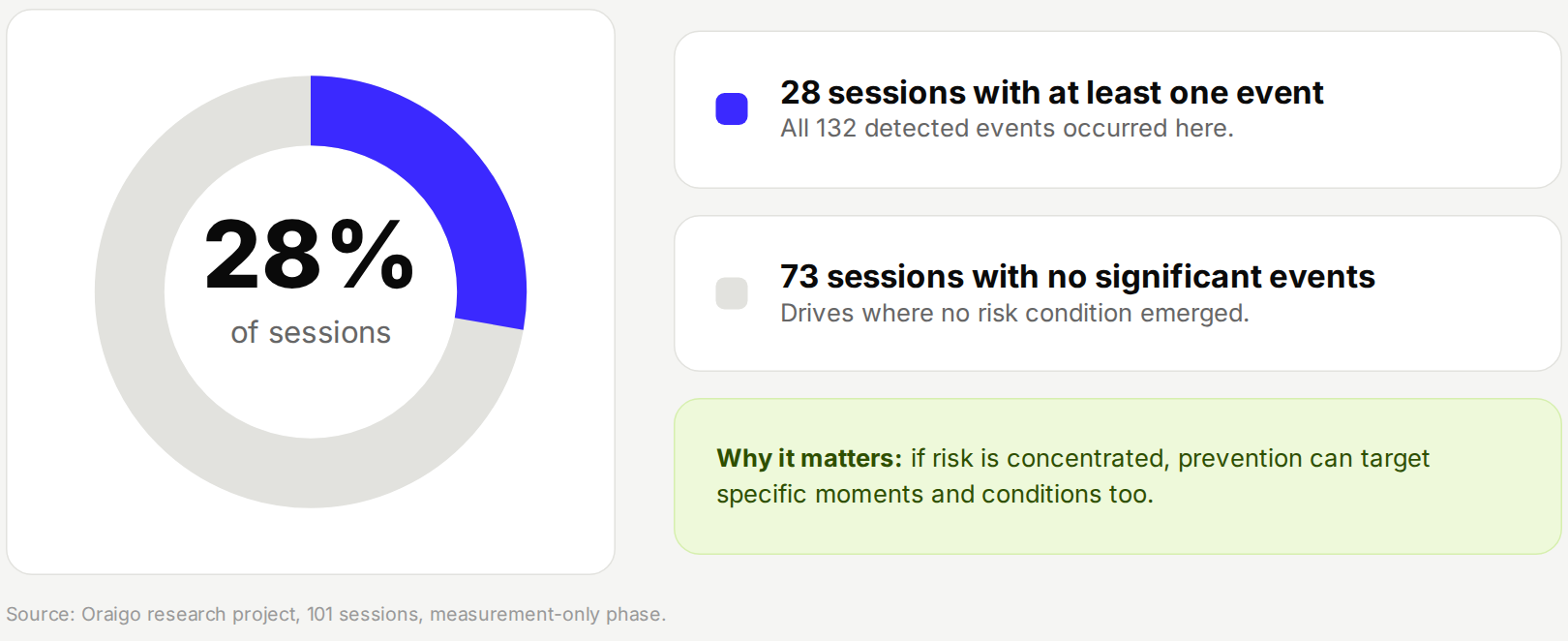
Across 101 sessions, about 6,600 minutes of driving, we detected 132 events. All of them occurred in 28 sessions: the other 73 showed nothing significant.
Early afternoon is the critical window
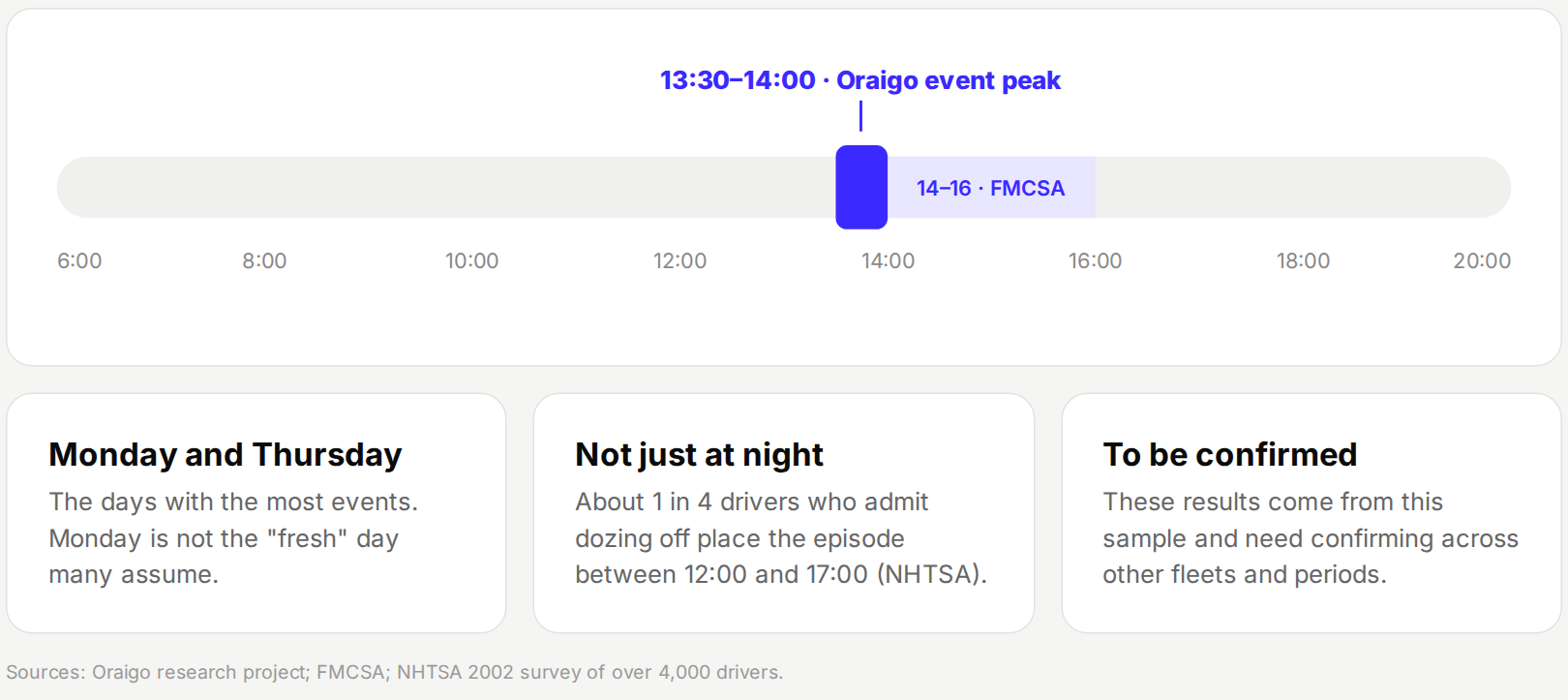
The peak matches FMCSA and NHTSA data: drowsiness is not only a night-time problem. The Monday and Thursday pattern still needs verifying across other fleets and periods.
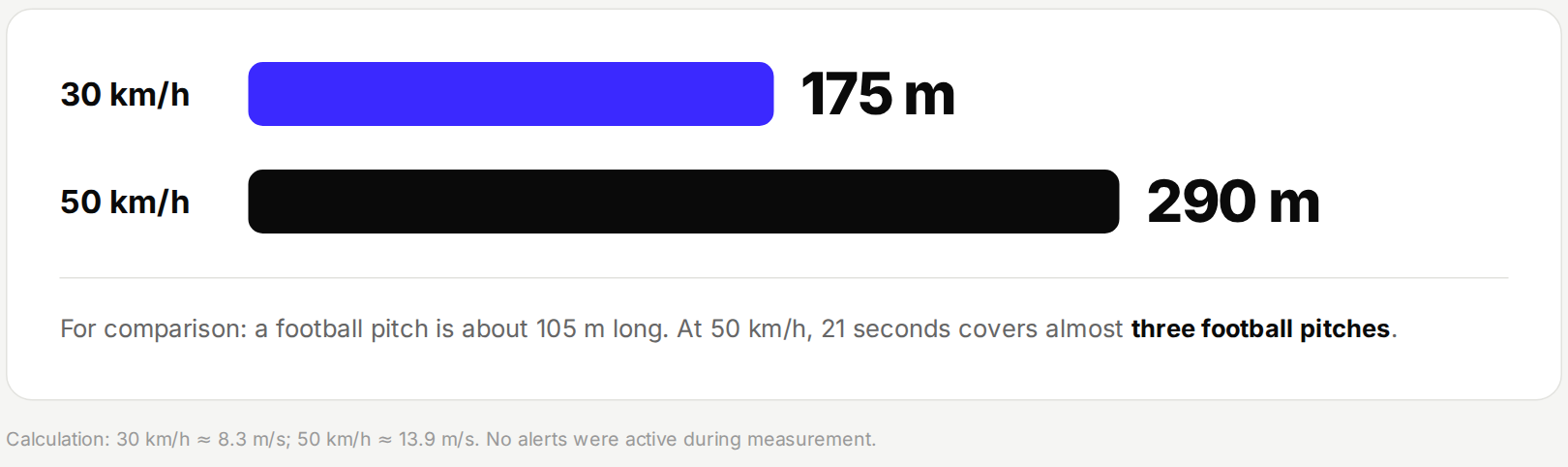
21 seconds without full alertness
The longest event lasted 21 seconds, and the driver was most likely unaware of it.
Want to see how fatigue is distributed across your fleet?
The method: measure, understand, train, prevent
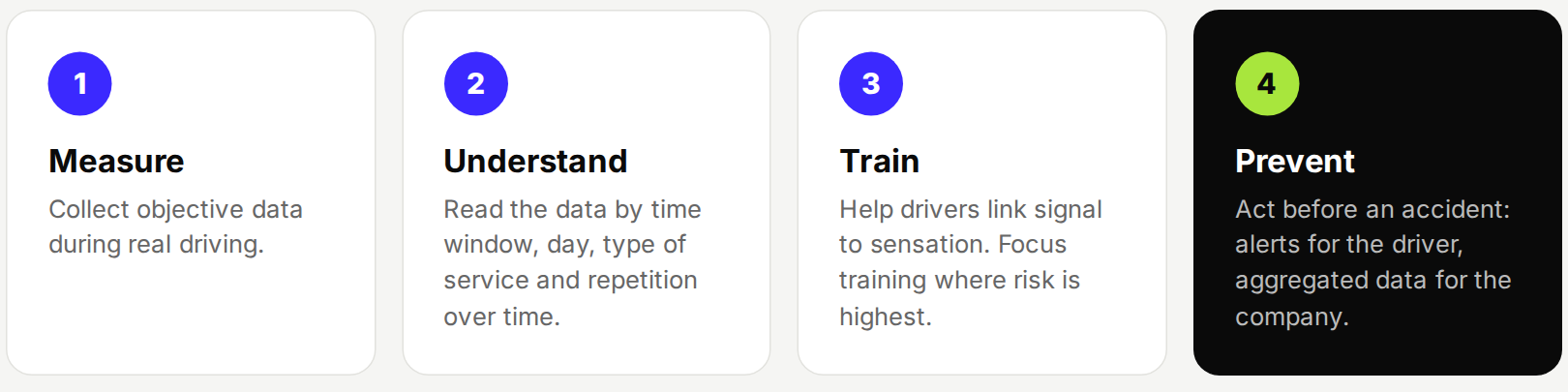
The point is not to say “we detected a microsleep”, but to ask what we can learn from it. The data raises precise questions:
- What time did shifts start? How long had drivers been working? Had they taken a break?
- Had they eaten? How much had they slept?
- Does the pattern repeat for the same person, or vary from driver to driver?
Drivers use alerts to understand themselves better. The company uses aggregated data to decide where to focus training and prevention, and to improve shift management.
What changes for fleet managers
- Visible risk, protected privacy: Fleets shows where and when risk concentrates at fleet level, never for the individual driver.
- Data-driven shifts: if early afternoon is critical, breaks and delivery scheduling can be rethought.
- Beyond the tachograph: a measure of actual alertness complements what the tachograph already records.
- Retention: a tool that helps rather than controls improves the relationship with drivers (read more).
- Most exposed sectors: long-shift deliveries, night transport, field services, passenger transport. All the data is in our fatigue report.
About Oraigo
A neurotechnology company developing Brain Computer Interface systems, software and proprietary algorithms. Member of ALIS, the Association for Sustainable Intermodal Logistics.
~1,200 EEG data points per second
7bn+ data points collected in real driving
800+ potential risk situations detected
These figures are separate from the pilot project described above.
Conclusion: the person at the wheel stays at the centre
We measure almost everything about the truck. We want to give the same opportunity to the people who drive it: not by controlling them, but by giving them information about themselves that they cannot always access alone.
Being tired is human. The goal is not a driver who never gets tired, but one who recognises when fatigue is becoming a risk. More information, more awareness, better decisions.