
Why Transport Safety Technology in the UK Matters More Than Ever
The United Kingdom has long been a world leader in road safety policy, but the rapid pace of technological change is reshaping what it means to keep drivers, passengers, and pedestrians safe on Britain’s roads. From motorways to city streets, the pressure on fleet operators, logistics companies, and transport authorities has never been greater. Rising accident costs, tightening regulations post-Brexit, and growing public expectations around corporate responsibility are pushing the industry toward smarter, more proactive solutions.
Transport safety technology in the UK is no longer a niche concern reserved for large logistics giants. It is becoming a baseline expectation across the sector, from small regional hauliers to national freight operators. The good news is that British roads are increasingly becoming a testing ground for some of the most exciting safety innovations in the world, and the results are beginning to show.
According to the Department for Transport, there were over 135,000 reported road casualties in Great Britain in a recent year alone. While long-term trends show improvement, progress has plateaued, and traditional approaches to safety, such as driver training programmes and compliance checks, are no longer sufficient on their own. The industry needs a new toolkit, and technology is stepping up to provide it.
This article explores the most significant developments in transport safety technology in the UK today, covering the tools making the biggest difference, the regulations shaping adoption, and the best practices fleet operators should follow to stay ahead of the curve.

The Shifting Landscape of UK Transport Safety Regulation
Before exploring the technology itself, it is worth understanding the regulatory environment driving its adoption. The UK operates under a complex framework of transport safety obligations, shaped by the Driver and Vehicle Licensing Agency (DVLA), the Driver and Vehicle Standards Agency (DVSA), and the Health and Safety Executive (HSE).
Since Brexit, the UK has retained much of the previous EU legislation around driver hours and vehicle standards, but it has also begun developing its own regulatory path. The introduction of the Highway Code updates in 2022, which strengthened protections for cyclists and pedestrians, signalled a broader cultural shift in how road safety is understood at a policy level.
The government’s Road Safety Statement and subsequent action plans have consistently highlighted technology as a key pillar of the national safety strategy. Initiatives such as the Centre for Connected and Autonomous Vehicles (CCAV) and Innovate UK funding streams have pumped millions of pounds into safety technology research and real-world trials on British roads.
For fleet operators, this regulatory momentum has practical implications. Vehicles are increasingly expected to come equipped with Advanced Driver Assistance Systems (ADAS) as standard. The EU’s General Safety Regulation, which the UK has partially mirrored, mandates features such as intelligent speed assistance, emergency braking, and lane-keeping systems for new vehicles sold in the market.
Understanding these regulatory drivers is essential because they determine not only what technology fleet operators must adopt but also which innovations are likely to receive public funding and achieve widespread market penetration in the years ahead.
Advanced Driver Assistance Systems: The New Standard
Advanced Driver Assistance Systems represent one of the most significant shifts in transport safety technology in the UK over the past decade. These are the technologies built directly into vehicles, designed to support drivers in real time and reduce the likelihood of human error, which remains the leading cause of road accidents.
Modern ADAS packages available in UK commercial vehicles now include autonomous emergency braking, which detects obstacles and applies the brakes without driver input. Lane departure warning systems alert drivers when their vehicle drifts out of lane without indicating, a common sign of fatigue or distraction. Blind spot monitoring uses radar sensors to flag vehicles in positions the driver cannot easily see in their mirrors.
Perhaps the most consequential development is the growing sophistication of intelligent speed assistance (ISA) technology. By reading road signs and GPS data, ISA systems can automatically limit vehicle speed to the posted limit, or at least warn drivers when they exceed it. For fleet operators managing drivers across hundreds of routes, this capability alone offers significant reductions in both accident risk and insurance liability.
The challenge for fleet managers is that not all ADAS implementations are equal. The quality of these systems varies considerably between manufacturers, and the data they generate is not always integrated into fleet management platforms in a meaningful way. The most forward-thinking operators are now selecting vehicles and technology providers based not just on the features available, but on the quality of the data pipeline those features create.
Telematics and Real-Time Fleet Monitoring
Telematics has been part of UK fleet management for well over a decade, but the sophistication of these platforms has accelerated dramatically. Today’s telematics systems go far beyond GPS tracking. They monitor driving behaviour in granular detail, capturing acceleration patterns, braking frequency, cornering forces, idling time, and fuel consumption, all streamed in real time to fleet management dashboards.
The value of this data for safety management is substantial. Transport safety technology in the UK is increasingly defined by the ability to move from reactive incident reporting to proactive risk identification. When a telematics system flags that a particular driver consistently exhibits harsh braking on a specific stretch of road, a fleet manager can intervene with targeted coaching before an accident occurs.
Connected telematics platforms are also beginning to integrate with external data sources, including live traffic data, weather conditions, and road hazard alerts. This environmental awareness allows systems to automatically flag high risk situations and suggest route adjustments, giving dispatchers and drivers the information they need to make safer decisions in real time.
Insurance companies have taken note. Usage-based insurance models, where premiums are calculated based on actual driving behaviour captured through telematics, are gaining traction across the UK fleet market. This creates a direct financial incentive for operators to invest in better monitoring technology and to use the resulting data to improve driver performance.
Driver Fatigue Monitoring: The Hidden Priority
Of all the safety challenges facing UK fleet operators, driver fatigue remains one of the most persistent and difficult to address. Research from the Royal Society for the Prevention of Accidents (RoSPA) estimates that driver fatigue is a contributory factor in up to 20 per cent of road accidents in the UK, and up to 25 per cent of fatal and serious crashes. These are sobering figures, and they underline why fatigue monitoring has become one of the fastest-growing segments of transport safety technology in the UK.
The fundamental problem with fatigue is that drivers are notoriously poor at self-assessing their own alertness levels. Studies consistently show that fatigued drivers believe they are performing adequately when their reaction times and decision-making have already been significantly impaired. Hours of service regulations, while important, do not account for the quality of rest a driver has had, their individual physiology, or the cumulative effects of circadian rhythm disruption caused by irregular shift patterns.
This is where modern fatigue monitoring technologies are making a genuine difference. Camera-based systems using AI-powered facial recognition can detect early signs of drowsiness such as slow eye blinks, extended eye closure, and head nodding, triggering in-cab alerts to prompt drivers to take a break. These systems have become more affordable and more accurate in recent years, and they are now widely deployed across UK fleets.
However, camera-based systems carry inherent limitations. They can only detect fatigue once it has manifested visibly in the driver’s behaviour, meaning they are reactive by nature. Performance can also be compromised by poor lighting conditions, the wearing of sunglasses, or variations in facial features, raising both accuracy and privacy concerns.
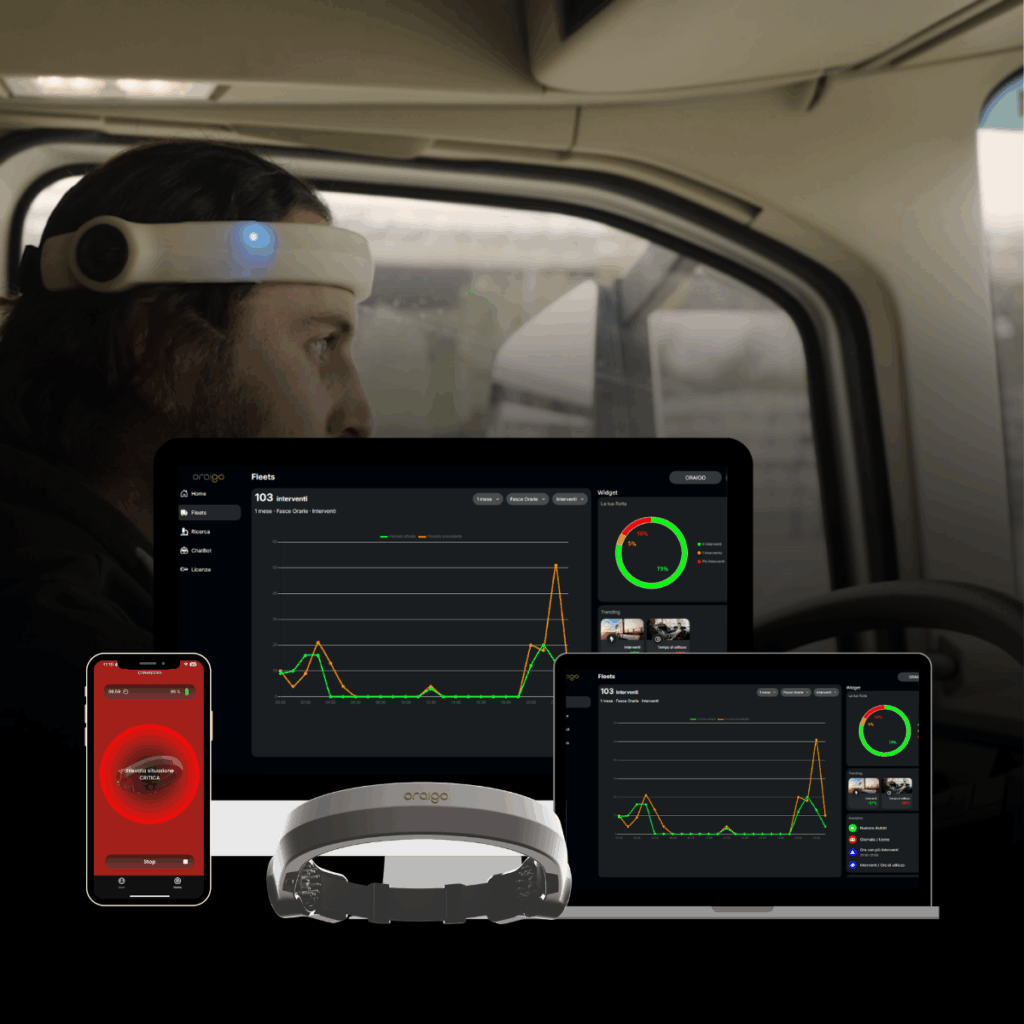
The most advanced approach to fatigue detection now uses physiological monitoring at the neurological level. EEG-based wearable devices, such as the Oraigo Aigo headband, monitor the driver’s brainwave activity continuously, identifying the neurological signatures of drowsiness before they produce any visible behavioural changes. Because these systems are measuring fatigue at its source, they can alert drivers significantly earlier than camera or vehicle-based alternatives, giving drivers more time to respond safely before the situation becomes critical.

For UK fleet operators serious about fatigue prevention rather than fatigue reaction, physiological monitoring represents the frontier of what is currently possible. The data these systems generate also feeds into fleet-wide analytics, allowing operators to identify patterns across their driver population and restructure shift schedules to minimise fatigue risk systematically.
Connected and Autonomous Vehicle Technology
The United Kingdom has positioned itself as a global hub for connected and autonomous vehicle (CAV) development, with trials taking place on public roads in locations including Bristol, Coventry, and Milton Keynes. While fully autonomous commercial vehicles remain some years away from widespread deployment, the safety technologies being developed for autonomous systems are already influencing the design of today’s driver-assisted vehicles.
Vehicle-to-everything (V2X) communication is one of the most promising emerging technologies in this space. It enables vehicles to communicate directly with other vehicles, roadside infrastructure, and traffic management systems. A lorry equipped with V2X technology can receive warnings about accidents ahead, changes in speed limits, or the presence of vulnerable road users at junctions, all before these hazards become visible to the driver.
The UK government’s investment in smart motorways, despite ongoing controversy around their safety, has also driven significant development in roadside sensor infrastructure that feeds data directly to connected vehicles. As this infrastructure matures, the safety benefits for commercial fleets are expected to be considerable.
For fleet operators, the practical implication is that vehicle procurement decisions made today will determine how well their fleets can integrate with the connected road networks of the next decade. Choosing vehicles with open data architectures and V2X readiness is becoming part of a responsible long-term fleet strategy.
Cybersecurity as a Transport Safety Issue
One dimension of transport safety technology in the UK that is often overlooked is cybersecurity. As commercial vehicles become more connected, they also become more vulnerable to digital threats. A cyberattack targeting a fleet management platform could compromise vehicle data, disable safety systems, or expose sensitive driver information. In extreme scenarios, vulnerabilities in connected vehicle systems could theoretically be exploited to interfere with vehicle operation directly.
The UK’s National Cyber Security Centre (NCSC) has identified the transport sector as a critical infrastructure priority, and regulators are beginning to extend cybersecurity requirements into vehicle and fleet technology standards. For fleet operators, this means that choosing technology vendors with robust security practices is not just a technical consideration. It is a safety and compliance imperative.
Transport safety technology in the UK is therefore becoming as much about securing digital systems as it is about installing physical safety hardware. Operators should scrutinise the data handling practices, encryption standards, and regulatory compliance credentials of every technology provider they work with.
Best Practices for Adopting Transport Safety Technology in the UK
The availability of powerful safety technology is only half the equation. Implementation quality determines whether that technology actually reduces accidents or simply generates data that sits unused on a dashboard.
Fleet operators achieving the best results tend to follow a structured approach. They begin with a thorough risk assessment of their specific operations, identifying the most significant hazard profiles across their routes, driver population, and vehicle types. This allows them to prioritise technology investments based on actual risk rather than marketing claims.
Piloting new technology across a small segment of the fleet before full deployment is a consistently recommended practice. A pilot programme allows operators to evaluate real-world performance, gather driver feedback, and build internal expertise before committing to a full rollout. Technologies that perform well in controlled tests can behave differently when deployed at scale across a diverse driver population.
Driver engagement is critical to successful adoption. Safety technology works best when drivers understand its purpose, trust its intentions, and feel supported rather than surveilled. Transparent communication about how data is collected, stored, and used is essential. Technologies that comply with the UK General Data Protection Regulation (UK GDPR) and anonymise driver data provide an important reassurance in this regard.
Integration with existing fleet management systems matters enormously. Fatigue alerts, ADAS event logs, and telematics data are most powerful when they are brought together in a single platform that enables meaningful analysis. Operators who maintain siloed data streams miss the broader patterns that reveal systemic safety risks.
Finally, building a culture of safety that extends beyond the technology itself remains the most important long-term investment. Regular safety briefings, recognition programmes for strong safety performance, and open channels for drivers to raise concerns create the organisational conditions in which technology can thrive.
Looking Ahead: The Future of Transport Safety Technology in the UK
The trajectory of transport safety technology in the UK points unmistakably toward greater connectivity, greater intelligence, and greater personalisation. Artificial intelligence will play an increasingly central role, not just in detecting risks but in predicting them based on patterns drawn from vast datasets spanning millions of vehicle hours.
Wearable physiological monitoring, real-time route risk scoring, and predictive maintenance systems that prevent mechanical failures before they cause accidents are all moving from prototype to mainstream deployment. The integration of mental health and wellbeing data into driver safety profiles represents perhaps the most humanising frontier of all, recognising that the person behind the wheel is as important as the vehicle they are driving.
For UK fleet operators, the message is clear. Investing in transport safety technology is not a regulatory burden to be managed. It is a strategic opportunity to protect drivers, reduce costs, and build the operational resilience that will define competitive advantage in the decades ahead. The tools are available, the regulatory direction is set, and the human case for action could not be more compelling.
Ready to Take Driver Safety to the Next Level?
If fatigue is one of the greatest hidden risks facing your fleet, Oraigo gives you the tools to address it at the source. Unlike reactive systems that wait for visible signs of drowsiness, Oraigo’s EEG-based brainwave monitoring detects fatigue at the neurological level, alerting drivers before the risk becomes a danger on the road.
Trusted by forward-thinking fleet operators and built to the highest data protection standards, Oraigo integrates seamlessly with your existing fleet management systems, giving supervisors real-time visibility and the insights needed to make smarter scheduling decisions across the entire operation.
Whether you are managing a regional haulage fleet or a national logistics network, Oraigo offers tailored pilot programmes designed to demonstrate real-world impact from day one.
Visit oraigo.com or book a call with one of our specialists to discover how brainwave monitoring can protect your drivers, reduce incidents, and future-proof your fleet safety strategy.