
Driver fatigue detection systems in Brazil are emerging as a critical priority for a transport sector that operates at a scale and under conditions that make fatigue one of the most persistent and dangerous risks on the road. Brazil has one of the largest road freight networks in the world, with trucks responsible for moving approximately 65% of all cargo across a country of continental proportions. The distances involved, the condition of many federal and state highways, and the relentless scheduling pressures faced by Brazilian drivers create an environment where fatigue is not an occasional risk but a daily operational reality.
For fleet operators, logistics companies, and transport regulators in Brazil, the challenge is no longer simply acknowledging that fatigue is dangerous. The challenge is building the systems, technologies, and cultures that can detect it early, respond to it effectively, and ultimately prevent it from claiming lives and destroying livelihoods. This article provides a comprehensive market overview of driver fatigue detection systems in Brazil, examining the scale of the problem, the regulatory context, the technologies available, and the path forward for fleets that are ready to act.

The Scale of Driver Fatigue in Brazil
To understand the market for driver fatigue detection systems in Brazil, it is first necessary to appreciate the scale of the road safety challenge the country faces. Brazil consistently ranks among the countries with the highest rates of road traffic fatalities in the world. According to the Observatório Nacional de Segurança Viária, Brazil records tens of thousands of road deaths annually, with heavy vehicle crashes accounting for a disproportionate share of fatal incidents on federal highways.
Fatigue is a significant and frequently underestimated contributor to this toll. Brazilian truck drivers routinely cover distances of 1,000 kilometres or more in a single journey, often on roads that pass through remote regions with limited access to rest areas, fuel stations, or emergency services. The BR-116, BR-101, and BR-364 are among the most travelled freight corridors in the country, and they are also among the most dangerous. Night driving, irregular rest patterns, and the economic pressure to meet tight delivery windows further compound the fatigue risk.
Research conducted in Brazil has found that a significant proportion of long-haul truck drivers regularly exceed recommended continuous driving limits and that many use stimulants, including caffeine and in some cases illicit substances, to manage fatigue rather than taking adequate rest. These coping strategies mask the physiological reality of fatigue without addressing it, creating a false sense of alertness that can give way suddenly and with devastating consequences.
The economic cost of fatigue-related crashes in Brazil runs to billions of reais annually when vehicle damage, cargo loss, medical costs, legal liability, and operational disruption are taken into account. For individual fleet operators, a single serious fatigue-related incident can be financially catastrophic. Understanding this context makes clear why driver fatigue detection systems in Brazil represent not just a safety investment but a fundamental business priority.
The Regulatory Landscape in Brazil
Brazil’s regulatory framework for driver fatigue management has evolved considerably over the past two decades, driven by a recognition that voluntary compliance alone is insufficient to address the scale of the problem. The central piece of legislation governing working hours for professional drivers is Lei 13.103 of 2015, known informally as the Lei dos Caminhoneiros or Truck Drivers Law. This legislation sets out maximum continuous driving periods, mandatory rest intervals, and daily and weekly limits on working hours for professional drivers of heavy vehicles.
Under Lei 13.103, long-haul drivers are required to take a 30-minute rest break after every four and a half hours of continuous driving, and total daily driving time is capped at ten hours. The law also introduced provisions for the use of electronic monitoring systems to verify compliance with these rules, and major fleet operators are required to maintain records of driver working hours that are subject to inspection by the Agência Nacional de Transportes Terrestres (ANTT), the federal agency responsible for regulating road freight transport in Brazil.
ANTT has progressively strengthened its enforcement of fatigue-related regulations and has worked alongside the Polícia Rodoviária Federal to conduct roadside inspections targeting non-compliant drivers and operators. Penalties for violations include fines, suspension of operating licences, and, in cases involving negligence that contributes to a fatal crash, criminal liability for fleet managers and company directors.
However, as is the case in other major markets, regulatory compliance and genuine fatigue prevention are not the same thing. A driver can comply fully with Lei 13.103, taking all required breaks and logging all required rest periods, and still arrive at the wheel in a physiologically fatigued state. Poor sleep quality, cumulative sleep debt, circadian rhythm disruption from night driving, and individual health factors can all produce meaningful fatigue impairment even in drivers who are technically within legal hours. This gap is precisely where modern driver fatigue detection systems in Brazil add value that regulation alone cannot provide.
The Human and Financial Cost of Inaction
Beyond the regulatory dimension, the human cost of fatigue-related road crashes in Brazil demands attention. Every fatal crash on a Brazilian highway represents a family’s loss, a community’s trauma, and in many cases the destruction of the financial security that a professional driver was working to provide. Brazilian truck drivers are often the primary income earners for their families, and the risks they face on the road are risks borne by entire households.
For fleet operators, the financial consequences of a serious fatigue-related incident extend far beyond the immediate costs of vehicle repair and cargo replacement. Legal proceedings in Brazil can result in substantial civil liability awards, particularly in cases where negligence in fatigue management can be demonstrated. Insurance premiums rise following incidents, and the reputational damage associated with a high-profile crash can affect client relationships and contract renewals for years.
There is also a growing dimension of corporate accountability in Brazilian transport. Large logistics clients and multinational companies with operations in Brazil are increasingly scrutinising the safety records and safety management systems of their transport providers. A fleet operator that cannot demonstrate a credible, technology-supported approach to fatigue management is at a growing competitive disadvantage as procurement practices evolve to incorporate safety performance criteria. Investing in driver fatigue detection systems in Brazil is therefore not only about protecting drivers but about protecting the long-term commercial viability of transport operations.
Types of Driver Fatigue Detection Systems Available in Brazil
The Brazilian market for driver fatigue detection technology has developed significantly in recent years, and fleet operators now have access to a range of systems that vary in their approach, accuracy, and integration capability. Understanding the options available is essential for making informed decisions about which technologies best suit the specific demands of Brazilian freight operations.
Physiological Monitoring Through EEG Technology
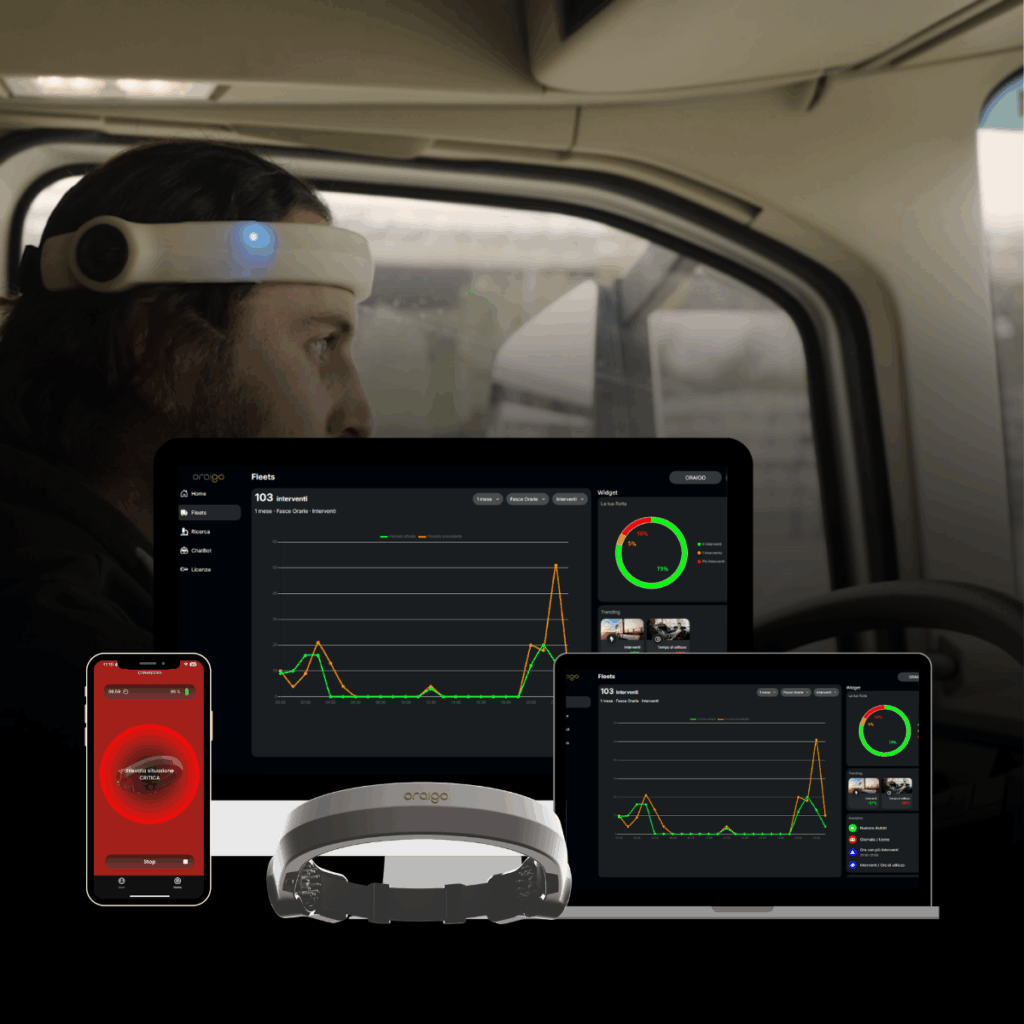
The most advanced category of driver fatigue detection systems currently available anywhere in the world, including in Brazil, is physiological monitoring based on electroencephalography. EEG-based wearable devices, such as the Oraigo Aigo headband, use sensors to continuously monitor the driver’s brainwave activity and identify the neurological changes associated with the transition from full alertness to early-stage drowsiness. These changes occur at the physiological level well before any visible signs of fatigue appear in the driver’s behaviour or on their face.

When the system detects early fatigue indicators, it immediately triggers multi-sensory alerts, combining audio, visual, and vibration signals to prompt the driver to respond. Fleet managers simultaneously receive notifications through an integrated dashboard, enabling real-time monitoring of driver fatigue status across the entire fleet and longer-term analysis of fatigue trends that can inform scheduling and route planning decisions. For the demanding conditions of Brazilian long-haul freight, where a driver may be alone on a remote federal highway for hours at a stretch, this level of proactive monitoring represents a genuinely transformative capability.
Camera-Based Systems Using Facial Recognition and Eye Tracking
Camera-based fatigue detection systems are currently the most widely deployed category of technology in Brazilian fleets. These systems use artificial intelligence and computer vision to continuously monitor the driver’s face, detecting physical indicators of drowsiness such as slow or prolonged eye closure, yawning, head drooping, and changes in gaze direction. When these indicators reach a threshold associated with significant fatigue, the system triggers an in-cab alert.
Camera systems have gained traction in Brazil partly because they integrate relatively easily into existing telematics and fleet management platforms that many operators already use. They provide a video record that can be used for post-incident analysis and driver coaching, and they do not require the driver to wear any additional device. However, their performance is dependent on adequate lighting conditions and can be compromised by sunglasses or facial obstructions, which are common in the bright sun and variable conditions of Brazilian highways. More fundamentally, camera systems detect fatigue only after it has progressed to the point of producing visible physical signs, making them reactive tools rather than preventative ones.
Vehicle Telematics and Behavioural Analysis Systems
Vehicle-integrated fatigue detection works by analysing patterns in driving behaviour to infer driver state. Continuous monitoring of lane keeping, steering input variability, braking frequency and intensity, and speed fluctuations allows these systems to identify patterns associated with impaired driving and trigger alerts when such patterns are detected. Many of the telematics platforms already in use by Brazilian fleet operators incorporate some level of fatigue-related behavioural monitoring.
The strength of these systems lies in their integration with existing fleet management infrastructure, making adoption straightforward for operators who already rely on telematics for GPS tracking, fuel management, and compliance reporting. Their limitation is the same as that of camera systems: they can only identify fatigue after it has manifested in driving behaviour, which represents a significant lag from the point at which neurological fatigue first develops. In the context of Brazilian highways, where traffic is often sparse and drivers may travel long stretches without external stimuli that might otherwise mask impaired performance, the lag between neurological fatigue onset and detectable behavioural change can be particularly consequential.
The Case for a Layered Approach
The most effective strategy for Brazilian fleet operators is to combine multiple detection technologies in a layered approach that monitors fatigue at different stages and through different data streams. An EEG-based system that detects early neurological fatigue provides the first layer of protection, issuing low-level alerts that prompt drivers to take a break while they are still sufficiently alert to respond safely. Camera-based monitoring provides a second layer that detects physical fatigue indicators if the driver does not act on the initial alert. Vehicle telematics provide a third layer that captures any degradation in driving performance as a further escalation signal.
This multi-modal approach minimises both false positives, which cause unnecessary disruption and erode driver trust in the technology, and false negatives, where fatigue goes undetected until it is already dangerous. The combined data also provides fleet managers with a much richer analytical foundation for understanding fatigue risk across their operations, enabling smarter decisions about scheduling, route design, and driver support.
Implementing Fatigue Detection Systems: Practical Guidance for Brazilian Fleets
Deploying driver fatigue detection systems in Brazil requires careful planning, stakeholder engagement, and a willingness to treat implementation as an ongoing process rather than a one-time installation. The following principles are drawn from best practice in markets where fatigue monitoring technology has been successfully adopted at scale.
Begin with a structured pilot programme covering a representative selection of vehicles and routes. The specific conditions of Brazilian freight operations, including road quality, climate variability, and the particular pressures of different freight corridors, will influence how fatigue patterns manifest and how detection systems perform. A pilot allows operators to gather real-world data, identify any operational adjustments needed, and build the internal evidence base for wider deployment.
Driver acceptance is a critical success factor that should not be underestimated. Brazilian truck drivers are a professional community with strong norms and a well-developed sense of occupational identity. Introducing monitoring technology without adequate explanation and genuine engagement is likely to generate resistance that undermines adoption. Operators who invest in transparent communication about what data is collected, how it is used, who has access to it, and what protections are in place consistently achieve better outcomes. Systems that anonymise sensitive biometric data and handle personal information with demonstrable care, such as those offered by Oraigo, make this communication significantly easier.
Integration with existing fleet management systems is essential for capturing the full operational value of fatigue data. When fatigue monitoring feeds into a centralised platform alongside GPS tracking, maintenance records, and hours-of-service compliance data, fleet managers gain a comprehensive view of risk that supports better decision-making across the organisation. Over time, the accumulated data enables predictive analytics that can identify which drivers, routes, and scheduling patterns carry the highest fatigue risk, allowing for targeted and cost-effective intervention.
Culture matters as much as technology. Fleets that achieve the best safety outcomes create environments where drivers feel comfortable acknowledging fatigue without fear of penalty or stigma, where rest is treated as an operational requirement rather than a personal weakness, and where the company’s commitment to safety is visible in daily management practice.
The Road Ahead for Driver Fatigue Detection in Brazil
The market for driver fatigue detection systems in Brazil is at an inflection point. Regulatory pressure is increasing, insurance economics are shifting to reward demonstrable safety investment, and client expectations around transport provider safety standards are rising. At the same time, the technologies available have advanced to the point where genuine physiological monitoring of driver fatigue is accessible, practical, and deployable at fleet scale.
Brazilian fleet operators who move now to adopt advanced fatigue detection technologies will be better positioned for the regulatory environment that is coming, better protected against the financial consequences of incidents, and better placed to attract and retain the clients and drivers who increasingly prioritise safety in their decision-making.
Oraigo’s EEG-based monitoring technology is available for Brazilian fleet operators seeking to raise their safety standards and bring genuine prevention capability to their fatigue management approach. A tailored pilot programme is the most effective way to experience the difference that real-time neurological monitoring can make in the specific conditions of your operation.
Visit oraigo.com or speak with one of Oraigo’s specialists to discover how driver fatigue detection systems can protect your drivers, reduce your operational risk, and contribute to a safer road freight sector in Brazil.