Driver fatigue detection systems in Australia have become a central focus for fleet operators, transport regulators, and road safety advocates alike. As the country’s road freight network continues to expand across vast distances and challenging conditions, the risks associated with driver fatigue have grown in parallel. Australia’s unique geography, with long-haul routes spanning thousands of kilometres through remote and regional areas, creates an environment where fatigue is not just a risk but a near-constant operational challenge.
For fleet managers, the stakes are high. Fatigue-related incidents result not only in driver injuries and fatalities but also in significant financial, legal, and reputational consequences. The good news is that the technology now exists to detect fatigue early, before it becomes dangerous. This article provides a comprehensive market overview of driver fatigue detection systems in Australia, covering the regulatory landscape, available technologies, implementation strategies, and the future direction of this rapidly evolving sector.

Why Fatigue Remains a Critical Road Safety Issue in Australia
Australia consistently ranks among the countries with the highest rates of fatigue-related heavy vehicle crashes. According to the National Heavy Vehicle Regulator (NHVR), fatigue is identified as a contributing factor in approximately 30% of offenses in Australia. This figure significantly exceeds global averages and reflects the particular demands placed on Australian truck drivers, many of whom cover remote routes with limited access to rest facilities or emergency services.
The causes of driver fatigue in Australia mirror global patterns but are compounded by local conditions. Extended driving hours, night shifts, irregular scheduling, and the monotony of long straight highways through remote outback terrain all contribute to what experts call highway hypnosis, a state where drivers become semi-drowsy despite technically remaining awake. Sleep disorders, inadequate rest, physical strain, and extreme temperatures further heighten the risk.
When fatigue sets in, the consequences are physiological and measurable. Reaction times slow, situational awareness deteriorates, and drivers may experience microsleeps lasting only a few seconds but long enough at highway speeds to cause a fatal collision. Understanding the scale and nature of this problem is the first step toward meaningful prevention, and that is precisely where modern driver fatigue detection systems in Australia are making a difference.
The Regulatory Landscape Shaping Fatigue Management in Australia
Australia has one of the more structured regulatory frameworks for heavy vehicle fatigue management in the world. The Heavy Vehicle National Law (HVNL), administered by the NHVR, sets out prescriptive fatigue rules that govern how long drivers can operate and when they must rest. Under this framework, drivers are required to log their work and rest hours, either manually or through electronic work diaries (EWDs), which function similarly to the Electronic Logging Devices (ELDs) mandated in the United States.
However, regulations alone have proven insufficient to eliminate fatigue-related incidents. Compliance-based approaches are inherently reactive. They measure hours on paper but cannot account for the actual physiological state of a driver. A driver who has taken the required rest may still be fatigued due to poor sleep quality, an underlying sleep disorder, or cumulative sleep debt built up over many days. This gap between regulatory compliance and real-world safety outcomes has driven growing demand for technology-based driver fatigue detection systems in Australia that go beyond scheduling and self-reporting.
Australian regulators are increasingly supportive of technology adoption. The NHVR has published guidance on the use of fatigue monitoring technologies, and several state governments have partnered with technology providers to trial advanced detection systems on high-risk freight corridors. The policy direction is clear: technology and regulation must work together to close the safety gap.
The Cost of Fatigue to Australian Fleet Operators
The financial impact of fatigue-related incidents on Australian fleet operators is substantial. A single serious crash involving a heavy vehicle can result in costs running into the millions of dollars when vehicle repairs, cargo damage, insurance premiums, legal fees, regulatory fines, and lost operational capacity are taken into account. The Australian Trucking Association has estimated that the total social cost of heavy vehicle crashes in Australia exceeds $3 billion annually, with fatigue a major contributing factor.
Beyond direct financial losses, fleet operators face significant reputational risk. Clients and supply chain partners increasingly scrutinise the safety records of transport providers, and a serious fatigue-related incident can result in lost contracts and long-term brand damage. There is also growing pressure from insurers, who are beginning to reward fleets that deploy advanced safety technologies with lower premiums.
The human cost, of course, is the most devastating. Australian truck drivers who suffer fatigue-related crashes face the physical and psychological toll of serious injury, and the families of those killed in such incidents carry an irreplaceable loss. For fleet managers who genuinely care about the wellbeing of their workforce, investing in robust driver fatigue detection systems in Australia is not merely a compliance exercise but a moral responsibility.
Types of Driver Fatigue Detection Systems Available in Australia
The Australian market for driver fatigue detection systems has matured significantly over the past decade. Fleet operators now have access to a range of technologies that vary in their detection methodology, accuracy, and integration capability. Understanding the differences between these systems is essential for making informed procurement decisions.
Physiological Monitoring Systems Using EEG Technology
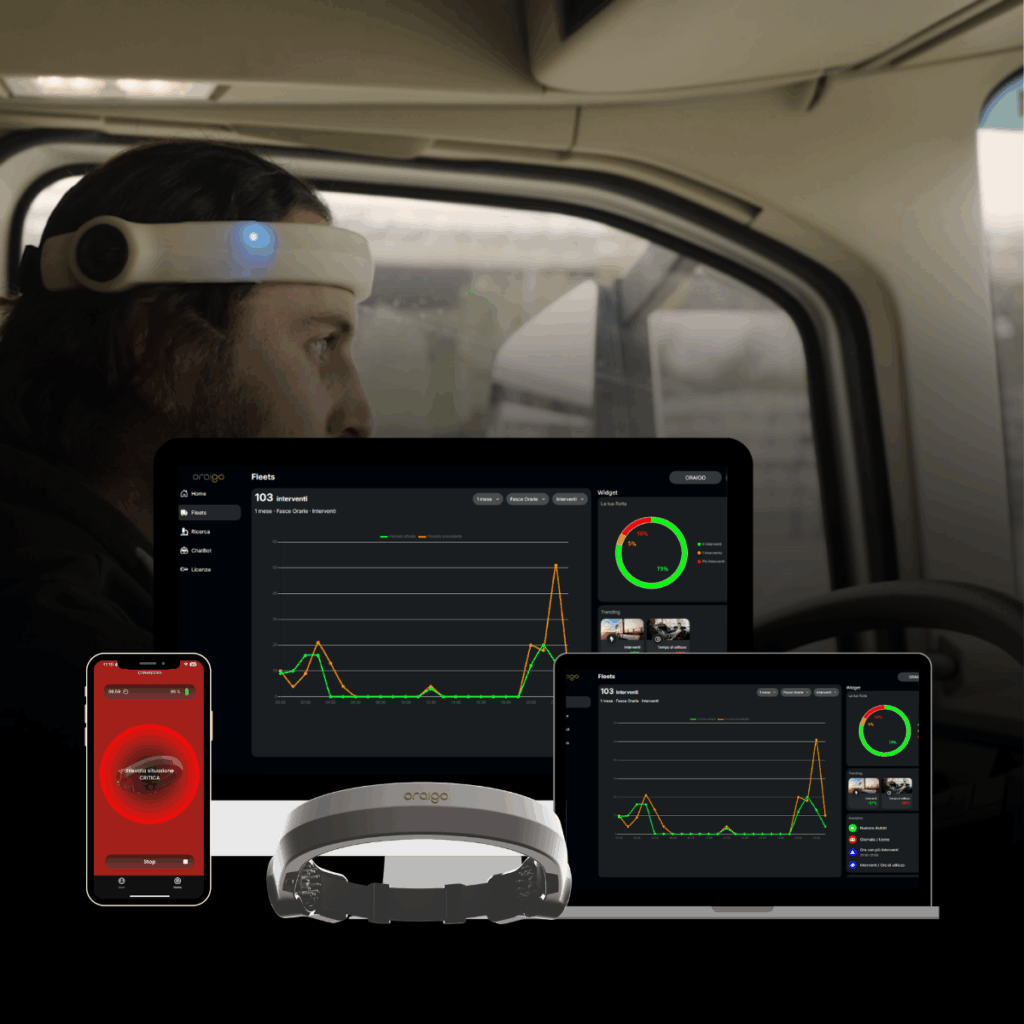
The most advanced approach to fatigue detection currently available involves monitoring the driver’s brain activity in real time using electroencephalography (EEG). Wearable EEG devices, such as the Oraigo Aigo headband, use sensors to continuously measure brainwave patterns associated with the transition from alertness to drowsiness. Because these changes occur at the neurological level before any visible behavioural signs appear, EEG-based systems offer the earliest possible warning of fatigue onset.
When the system detects early-stage fatigue, it immediately triggers multi-sensory alerts including audio, visual, and vibration cues to prompt the driver to take action. Fleet supervisors simultaneously receive notifications through an integrated dashboard, enabling real-time intervention and longer-term analysis of fatigue trends across the fleet. This proactive, data-driven approach is increasingly recognised as the gold standard for driver fatigue detection systems in Australia, particularly for high-risk long-haul operations.

Camera-Based Facial Recognition and Eye-Tracking Systems
Camera-based systems represent the most widely deployed category of fatigue detection technology in Australia. These systems use artificial intelligence and computer vision to monitor the driver’s face continuously, detecting indicators of drowsiness such as slow eye blinks, prolonged eyelid closure, yawning, and head nodding. When these signs are identified, the system triggers an in-cab alert.
Camera-based systems are popular because they are relatively straightforward to install, do not require the driver to wear any device, and provide a visual record that can be used for incident review and driver coaching. However, their performance can be compromised by poor lighting conditions, sunglasses, facial obstructions, and privacy considerations in certain jurisdictions. Critically, they can only detect fatigue once it has progressed to the point of producing visible physical signs, making them inherently reactive rather than preventative compared to physiological monitoring approaches.
Vehicle Telematics and Behavioural Monitoring Systems
Vehicle-integrated fatigue detection systems analyse driving behaviour patterns to infer driver state. Parameters such as lane deviation frequency, steering input variability, braking patterns, and speed fluctuations are monitored continuously. When the system identifies patterns consistent with impaired driving, it issues an alert and logs the event for fleet review.
These systems are often embedded within broader telematics platforms that Australian fleet operators already use for GPS tracking, fuel management, and compliance reporting. Their integration into existing infrastructure makes adoption relatively low-friction. However, like camera-based systems, they detect fatigue only after it has manifested in driving behaviour, which represents a significant lag from the point at which neurological fatigue first develops. They are best understood as a complementary layer within a broader safety strategy rather than a standalone solution.
A Multi-Modal Approach to Fatigue Detection
Leading safety researchers and fleet operators increasingly advocate for a layered approach that combines multiple detection methodologies. By integrating EEG-based physiological monitoring with camera-based facial analysis and vehicle telematics, fleets can create a safety system that detects fatigue at multiple stages and through multiple data streams. This redundancy significantly reduces both false positives, which cause unnecessary disruption, and false negatives, where fatigue goes undetected.
In practice, an EEG system might detect early neurological signs of fatigue and issue a low-level alert, prompting the driver to take a short break. If the driver continues without acting, a camera-based system might subsequently detect physical signs of drowsiness and escalate the alert. Vehicle telematics data could simultaneously flag any degradation in driving performance. Each layer reinforces the others, and the combined data provides fleet managers with a rich picture of driver fatigue patterns across routes, time periods, and individual drivers.
Implementing Fatigue Detection Systems: Best Practices for Australian Fleets
Successful deployment of driver fatigue detection systems in Australia requires more than simply purchasing and installing technology. Fleet operators who achieve the best safety outcomes approach implementation as a change management process that encompasses technology, culture, training, and data governance.
Starting with a structured pilot program is strongly recommended. Selecting a subset of vehicles and routes that are representative of your broader fleet allows you to evaluate system performance in real-world Australian conditions, gather driver feedback, and refine your implementation approach before scaling up. This iterative process reduces the risk of costly mistakes and builds internal confidence in the technology.
Driver acceptance is a critical success factor that is frequently underestimated. Many drivers are initially resistant to fatigue monitoring technologies, viewing them as surveillance tools that imply distrust. Fleet operators who invest in thorough education and transparent communication see significantly better adoption outcomes. Drivers should understand how the system works, what data is collected, how it is used, and what rights they have over their personal information. Reputable systems such as Oraigo anonymise sensitive driver data and comply with applicable privacy regulations, including Australia’s Privacy Act 1988, which is an important assurance to provide to drivers and their representatives.
Integration with existing fleet management and telematics platforms is essential for maximising the value of fatigue data. When fatigue monitoring data flows into a centralised dashboard alongside GPS tracking, maintenance records, and compliance reporting, fleet managers gain a holistic view of operational risk that enables smarter decision-making. Data collected over time can be used to identify high-risk routes, optimise shift scheduling, and target driver support programs where they are most needed.
Finally, technology should be supported by a genuine culture of rest and wellbeing. Fleet operators who encourage drivers to speak openly about fatigue without fear of penalty, who schedule adequate rest periods, and who take a proactive interest in driver health and sleep quality create the conditions in which monitoring technology can be most effective. Technology alone cannot solve the fatigue problem; it must be embedded within a broader organisational commitment to safety.
The Future of Driver Fatigue Detection Systems in Australia
The Australian market for driver fatigue detection systems is evolving rapidly. Advances in artificial intelligence, wearable sensor technology, and data analytics are continuously improving the accuracy, usability, and affordability of these systems. Several trends are worth noting for fleet operators planning their medium and long-term safety investments.
EEG-based monitoring is expected to become more accessible as wearable device technology matures and costs decrease. The neurological data generated by these systems is also increasingly being used to build predictive fatigue models that can anticipate when a driver is likely to become fatigued based on historical patterns, route characteristics, and time of day. This shift from detection to prediction represents a significant leap forward in proactive safety management.
Regulatory evolution is also anticipated. As the evidence base for fatigue monitoring technology grows and its effectiveness becomes more clearly demonstrated, Australian regulators are likely to move toward mandating certain categories of fatigue detection systems for high-risk freight operations, much as they have done with electronic work diaries. Fleet operators who adopt these technologies now will be well positioned for compliance when such requirements emerge.
The integration of fatigue data with broader intelligent transport systems, including connected vehicle platforms and roadside infrastructure, is another frontier that Australian researchers and regulators are actively exploring. As these systems mature, driver fatigue detection will increasingly become part of a larger, network-wide approach to road safety rather than an isolated in-cab solution.
Taking Action: Moving from Awareness to Prevention
Driver fatigue detection systems in Australia have moved well beyond the experimental stage. The technology is proven, the regulatory environment is supportive, and the business case for investment is clear. What separates leading fleets from the rest is not awareness of the problem but the willingness to act on it with the urgency it deserves.
For fleet operators ready to make that move, the starting point is choosing technologies that match the specific risk profile of your operations. High-risk long-haul routes demand the most proactive solutions available, and EEG-based physiological monitoring represents the current frontier of that capability. Combining it with camera-based and vehicle-integrated systems creates the kind of robust, layered safety net that truly protects drivers and assets.
Oraigo’s brainwave monitoring technology is already helping fleets around the world detect fatigue before it becomes dangerous, and it is available for Australian fleet operators seeking to raise their safety standards. A tailored pilot program is the ideal way to experience the difference that real-time neurological monitoring can make in your specific operating environment.
Visit oraigo.com or speak with one of Oraigo’s specialists to learn how driver fatigue detection systems can protect your drivers, reduce your risk, and keep Australian roads safer for everyone.