The best driver monitoring systems for long-haul trucking are always evolving. From dashcams and lane-keeping alerts, to physiological monitoring systems, the market has a solution to meet every fleet’s specific needs.
However, not all systems are created equal. And the one, or combination of ones, that are optimal for your fleet are always obvious.
This article reviews the leading categories of driver monitoring systems for long-haul trucking, evaluates their strengths and limitations in the specific context of long-distance freight operations, and identifies what separates genuinely effective systems from those that offer compliance coverage without meaningful safety improvement.

What Is a Driver Monitoring System for Long-Haul Trucking and What Should It Do?
A driver monitoring system for long-haul trucking is any technology that tracks driver behaviour, physiological state, or vehicle performance with the goal of detecting impairment and preventing accidents before they occur. The best systems do three things well: they detect the earliest possible signs of fatigue or distraction, they alert the driver in time for a safe response, and they provide fleet managers with the data needed to understand and manage fatigue risk across their entire operation.
In the long-haul context, the emphasis must be on early detection. A driver covering 800 kilometres overnight on a motorway is not in the same risk environment as a driver making urban deliveries with frequent stops, interaction with traffic, and constant environmental stimulation. The monotony of long-haul driving suppresses the external cues that help maintain alertness, meaning fatigue can accumulate and deepen over hours without the driver registering its severity. By the time impairment is obvious, a monitoring system that has not already detected and responded to the problem has failed at its core function.
Why Long-Haul Trucking Demands a Different Standard of Monitoring
Long-haul trucking creates fatigue conditions that are categorically more demanding than other freight operations, and driver monitoring systems that perform adequately in urban or regional contexts may fall significantly short when deployed on overnight trunk routes.
The combination of factors that makes long-haul driving uniquely dangerous from a fatigue perspective is well-documented in transport safety research. Extended continuous driving periods, typically four to five hours between mandatory breaks, expose drivers to sustained monotony that promotes the gradual neurological slide toward drowsiness. Night driving disrupts circadian rhythms, reducing the restorative value of rest periods and increasing the physiological pressure toward sleep during the early hours of the morning, when fatigue-related crash rates are consistently highest. Remote routes through desert, mountain, or agricultural terrain reduce external stimulation further, removing the ambient alerting effect that urban traffic and frequent road features provide.
Long-haul drivers also face the particular challenge of cumulative fatigue across multi-day operations. A driver who completes a demanding overnight run, takes the required rest period, and then begins another long-haul shift the following evening may be technically compliant with hours of service regulations while carrying a physiological fatigue burden that compounds across the working week. Driver monitoring systems that only assess fatigue within a single shift, without the analytical capability to identify cumulative patterns across days and routes, miss a significant dimension of long-haul fatigue risk.
The Main Categories of Driver Monitoring Systems for Long-Haul Trucking
Understanding what is available in the market requires a clear taxonomy of monitoring approaches, each of which operates on a different detection methodology and delivers a different level of protection in long-haul operating conditions.
EEG-Based Physiological Monitoring Systems
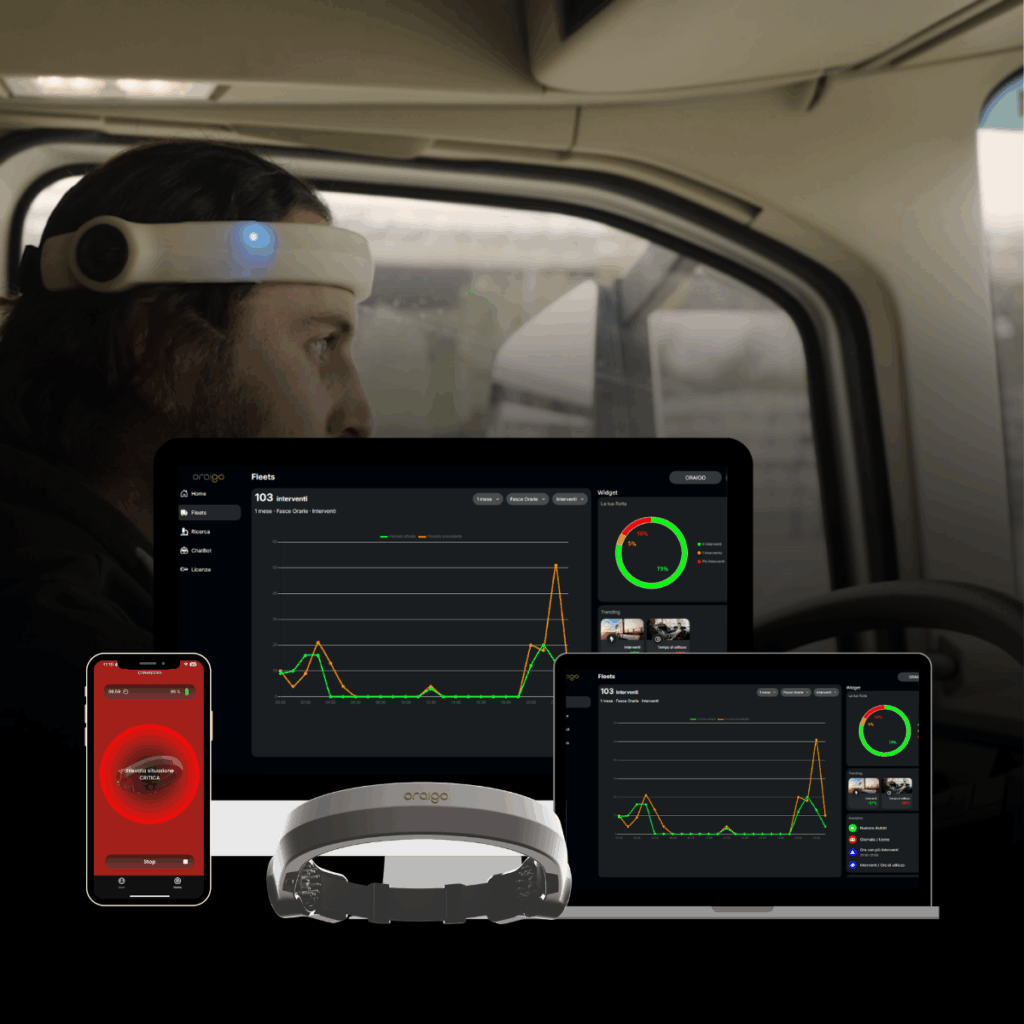
EEG-based driver monitoring systems are the most advanced category available for long-haul trucking in 2025, and they represent the most significant development in commercial driver safety technology of the past decade. These systems use electroencephalography sensors in a wearable device, such as the Oraigo Aigo headband, to continuously monitor the driver’s brainwave activity throughout a shift. The neurological transition from full alertness to early drowsiness produces characteristic and measurable changes in brainwave patterns that EEG sensors detect with precision, generating alerts before any physical signs of fatigue are visible.
The relevance of this early neurological detection to long-haul operations cannot be overstated. A long-haul driver experiencing the initial stages of neurological fatigue at 2am on a remote motorway is in a situation where the external environment provides no natural alerting stimulus and where the distance to the next safe stopping point may be significant. An alert that arrives at the neurological onset of drowsiness gives that driver several minutes of cognitive capacity and reaction time to find a rest area and stop safely. An alert that arrives only when the driver is visibly nodding or drifting across lane markings may give seconds.
The Oraigo system delivers alerts through a combination of audio, visual, and vibration signals designed to penetrate the sensory cocoon of a long overnight shift. Fleet managers simultaneously receive real-time notifications through an integrated dashboard, providing visibility of driver fatigue status across the entire fleet at any moment. The continuous physiological data generated by EEG monitoring accumulates over time into a powerful analytical resource, revealing fatigue patterns across specific routes, time periods, individual drivers, and scheduling structures that no other monitoring approach can match.
For long-haul fleet operators in 2026, EEG-based monitoring represents the current gold standard in driver monitoring technology, offering capabilities that go well beyond compliance documentation into genuine, physiologically grounded accident prevention.

Camera-Based Driver Monitoring Systems
Camera-based driver monitoring systems use artificial intelligence and computer vision to track the driver’s face continuously, detecting physical indicators of drowsiness and distraction including slow eye blinks, prolonged eyelid closure, yawning, head drooping, and gaze direction. These systems have become significantly more sophisticated over the past five years and are now standard equipment on many new heavy vehicle models sold in Europe, North America, and Australia, driven partly by regulatory mandates under frameworks such as the EU General Safety Regulation.
For long-haul trucking, camera systems offer genuine value as part of a broader monitoring architecture. Their integration with existing telematics platforms is well-established, their video evidence records have clear value for incident review, insurance claims, and driver coaching, and their passive operation, requiring no active participation from the driver, simplifies deployment and removes a compliance variable.
However, camera systems face a fundamental limitation in the long-haul context that their increasing sophistication has not resolved: they detect fatigue only after neurological impairment has progressed to visible physical symptoms. In urban driving, where frequent stops, traffic interaction, and environmental stimulation provide regular natural breaks in the fatigue accumulation cycle, this detection lag is less consequential. In long-haul driving, where impairment can deepen steadily over hours without external interruption, the gap between neurological fatigue onset and visible symptom detection represents a prolonged and unmanaged risk window that camera systems alone cannot close.
Night driving presents additional performance challenges for camera-based systems. Illumination requirements for consistent facial recognition can be difficult to meet in the variable lighting conditions of overnight long-haul operations, and many drivers wear sunglasses during daytime portions of long shifts, partially obscuring the facial features that detection algorithms depend upon.
Vehicle Telematics and Behavioural Monitoring Systems
Vehicle-integrated driver monitoring analyses driving behaviour patterns to infer driver state, monitoring parameters such as lane keeping consistency, steering input variability, braking frequency and intensity, speed fluctuation, and following distance management. These systems are widely deployed in long-haul fleets, often as components of broader telematics platforms that also handle GPS tracking, fuel management, hours of service compliance, and route optimisation.
The integration advantages of telematics-based monitoring are real and significant for fleet operators who already rely on these platforms. Adding fatigue-related behavioural analysis within existing management infrastructure requires minimal additional investment and provides fleet managers with data that flows directly into familiar operational workflows.
In long-haul operating conditions, however, the limitations of purely behavioural monitoring are particularly pronounced. On well-maintained motorways with clear lane markings and light traffic, which describe a substantial proportion of long-haul route environments, a fatigued driver may maintain superficially adequate lane discipline and speed consistency for extended periods before neurological impairment produces detectable behavioural deterioration. The monotony that makes long-haul driving so fatigue-inducing also tends to produce a narrow and predictable driving envelope that masks impairment until it becomes severe. Telematics systems are most valuable as a third detection layer and a compliance management tool, not as a primary fatigue prevention mechanism for high-risk long-haul operations.
Distraction and Attention Monitoring Systems
A distinct but related category of driver monitoring technology focuses on attention and distraction rather than fatigue specifically. These systems monitor driver gaze direction, head orientation, and interaction with in-cab devices to detect when attention has moved away from the road. Mobile phone use detection, forward collision warning integration, and driver engagement scoring are common features of this category.
For long-haul trucking, attention monitoring systems address a real and important risk dimension that is distinct from fatigue but often co-occurs with it. A driver who is fatigued is also more likely to engage in attention-diverting behaviours as a compensatory strategy, and a monitoring system that can detect both physiological fatigue and attentional distraction provides a more comprehensive safety picture than one that addresses either in isolation. The best driver monitoring architectures for long-haul trucking in 2025 increasingly integrate fatigue and attention monitoring within a unified platform.
What the Best Driver Monitoring Systems Have in Common
Across all categories, the driver monitoring systems that deliver the best safety outcomes in long-haul trucking share several characteristics that separate genuinely effective solutions from compliance-oriented products.
Early detection is the most important. The systems that prevent accidents rather than document them are those that detect driver impairment at the earliest possible stage, whether through neurological monitoring, advanced behavioural analysis, or the combination of both. For long-haul operations, early detection means EEG-based physiological monitoring at the primary layer.
Fleet-wide visibility is essential. A monitoring system that alerts the driver but provides no fleet management visibility leaves operators dependent on the fatigued driver to make safe decisions and take appropriate action. The best systems provide simultaneous real-time notification to fleet managers, enabling intervention, rerouting, or driver relief when an individual driver alert is not acted upon.
Analytical depth distinguishes leading systems from basic alert tools. The continuous data streams generated by advanced monitoring systems, when properly integrated into fleet management platforms, enable the kind of fatigue pattern analysis that allows operators to address the structural causes of fatigue risk rather than merely responding to individual incidents. This analytical capability is particularly valuable in long-haul operations where route characteristics, scheduling patterns, and cumulative workload create predictable fatigue risk profiles that can be identified and addressed proactively.
Driver acceptance determines real-world effectiveness. A monitoring system that drivers disable, work around, or resent delivers a fraction of its potential safety value. The systems that achieve the best adoption outcomes are those that are clearly and genuinely oriented toward driver protection, that handle personal and biometric data with transparent privacy protections, and that are introduced through genuine engagement with drivers rather than imposed without consultation.
Building the Optimal Driver Monitoring Architecture for Long-Haul Trucking
The optimal driver monitoring system for long-haul trucking in 2025 is not a single product but a layered architecture that combines the strengths of multiple technologies. EEG-based physiological monitoring at the primary layer provides the earliest possible detection at the neurological source of fatigue. Camera-based facial monitoring at the secondary layer captures visible symptoms if a driver does not respond to the initial alert. Vehicle telematics at the tertiary layer detects any resulting deterioration in driving performance as a further escalation signal. Attention and distraction monitoring integrated across the architecture provides complementary coverage of the non-fatigue impairment risks that are also elevated in long-haul operations.
This layered approach minimises both false positives, which disrupt operations and erode driver trust, and false negatives, where fatigue progresses to a dangerous level without triggering an adequate response. The combined data from multiple monitoring layers provides a safety net that is substantially more robust than any single technology, and a data foundation for analytical risk management that no individual system can match.
Getting Started with Advanced Driver Monitoring for Long-Haul Trucking
Fleet operators ready to move beyond first-generation monitoring technology should begin with a structured pilot programme that evaluates advanced physiological monitoring under their specific long-haul operating conditions. A well-designed pilot generates the performance data, driver feedback, and return on investment evidence needed to support confident fleet-wide deployment decisions.
Oraigo’s EEG-based Aigo system is specifically designed for the demands of professional long-haul operations and is available for fleet operators seeking to build a driver monitoring architecture that genuinely prevents fatigue-related accidents rather than documenting them after the fact.
Visit oraigo.com or speak with one of Oraigo’s specialists to find out how to build the right driver monitoring system for your long-haul fleet in 2025.