

We deployed Aigo’s EEG-based fatigue monitoring on just 2 drivers of a 100 + driver commercial latin american fleet. The results revealed a hidden layer of risk that no traditional safety measure had ever detected.
KEY FIGURES
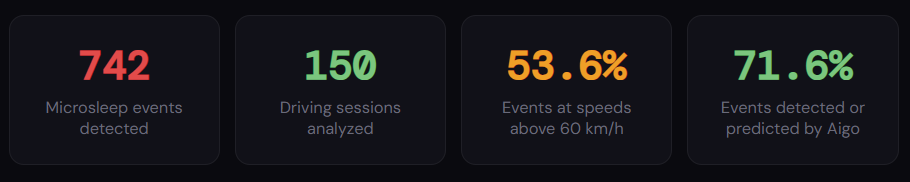
The context: a real-world fatigue study
In early 2026, a major transport company operating in Latin America with a fleet of more than 100 drivers agreed to participate in a fatigue and drowsiness study using Oraigo’s ecosystem. The study monitored 2 drivers over a 6-week period, covering 23,924 minutes of driving time across 150 sessions.
The goal was straightforward: use objective, EEG-based brain monitoring to measure what no camera, questionnaire, or self-report can see: the actual cognitive state of the driver in real time.
Microsleeps are involuntary lapses of attention lasting 1 to 6+ seconds. They are invisible to the driver and to anyone watching from outside the cab. But they are measurable through brain signals.
What we found in the report of this latin american fleet exceeded every expectation, both in terms of the risk uncovered and in Aigo’s ability to detect truck driver fatigue.
The invisible driver: 98% of the risk in one person
The most striking finding was the extreme concentration of risk. Out of 742 detected microsleep events, 98.08% were attributed to a single driver. The other driver accounted for just 1.92%.
This finding is important not for the purpose of punishing and singling out this driver, but to understand that, when risk is concentrated in one person, a minimal and targeted intervention can have a tremendous impact on safety.
Helping this driver understand his dangerous hours, his most energized hours, and any other pattern with his driving, improves his safety and productivity on the road..
Before this study, there was no way to know that one of these two drivers represented a critical safety risk. Both held valid licenses, both passed standard medical checks, both had been driving professionally for years.
This is the core insight: traditional safety measures are blind to fatigue risk. Without objective brain monitoring, this driver would have continued operating heavy vehicles across highways, accumulating microsleeps at a rate of over 100 per week, completely undetected.
The high-risk driver’s profile showed sessions with up to 59 microsleep events in a single trip, meaning the driver fell asleep at the wheel dozens of times during one journey without stopping. The session-free drowsiness rate for this driver fluctuated between 30% and 65% week to week, never reaching a safe baseline.
When and where microsleeps happen
Time of day: the late-night peak
The data revealed a clear circadian pattern. The highest concentration of microsleeps occurred between 21:00 and midnight, with the absolute peak at 23:30–00:00, reaching approximately 80 events in that 30-minute window alone. A secondary cluster appeared between 00:00 and 02:00, and a third in the early morning hours (05:00–07:00).
During daytime hours (08:00–16:00), events were sporadic, confirming that the primary risk factor was night driving combined with accumulated fatigue.
Day of the week: the Thursday spike
The weekly pattern revealed a clear fatigue accumulation cycle:
• Monday: 120 microsleeps — baseline level after weekend rest
• Wednesday: 199 microsleeps — fatigue building, average interval between consecutive events drops to just 20 minutes
• Thursday: 324 microsleeps — peak risk day, nearly 3x Monday’s level. This is the weekly breaking point.
• Saturday–Sunday: 26 and 13 microsleeps respectively — dramatic drop due to reduced driving activity
This Monday-to-Thursday escalation is a textbook pattern of cumulative sleep debt. Drivers who don’t get adequate rest between shifts accumulate fatigue across the week until it reaches a critical threshold — in this case, Thursday.
Speed: the danger multiplier
This is where the data becomes most concerning from a safety perspective:
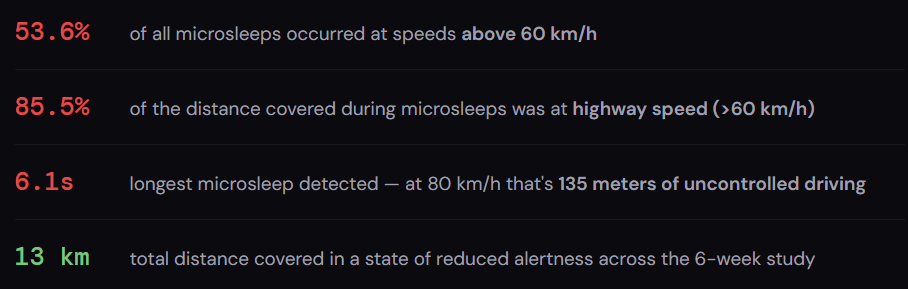
To put this in perspective: the drivers covered 13 km out of 8,986 km total while experiencing microsleep events. That’s 0.14% of total distance — but in those 13 kilometers, the driver had no cognitive control over the vehicle. At highway speed, a 2-second microsleep means 44 meters with nobody at the wheel.
Aigo’s detection capability: what would have changed
Across the study, Aigo’s algorithms detected or predicted 531 out of 742 microsleep events (71.56%). This breaks down into:

With active alerting enabled, the system could have warned the driver through sound, visual, and haptic alerts before or during the majority of microsleep episodes. The study showed that activating Aigo’s alert system would have increased drowsiness-free sessions from 65.3% to 67.3% — but this understates the true impact.
The 67.3% figure only counts sessions where every single microsleep would have been prevented. In reality, even partial prevention, reducing 59 microsleeps in a session to 5, represents a massive safety improvement. The real metric is this: 531 times, a driver would have been alerted before or during a dangerous loss of attention.
The fleet-wide question
If 2 drivers produced 742 microsleep events in 6 weeks, with one driver completely invisible to traditional safety measures, how many undetected high-risk drivers exist among the remaining 105?
This is the question that transforms a pilot study into a fleet-wide safety imperative. Conservative estimates based on international research on undiagnosed sleep disorders in professional drivers suggest that 10-15% of any commercial fleet may include drivers with elevated fatigue risk profiles. For a 107-driver fleet, that’s 11 to 16 drivers potentially operating in conditions similar to the high-risk driver in this study.
The projected impact on an unmonitored fleet of this size includes thousands of microsleep events per quarter, dozens of kilometers driven under reduced alertness, and a measurable increase in accident probability, all of it invisible without objective cognitive monitoring.
What the data tells fleet operators
KEY TAKEAWAYS FOR FLEET SAFETY MANAGERS
• Traditional screening misses the real risk. Medical checks, self-reports, and camera-based systems cannot detect microsleeps. Only direct brain monitoring provides objective, real-time measurement of cognitive state.
• Risk concentration means a small intervention has outsized impact. In this case, addressing one driver’s fatigue profile would have eliminated 98% of all microsleep events in the fleet sample.
• Weekly fatigue patterns are predictable and preventable. The Monday-to-Thursday escalation follows the same curve every week. This means scheduling interventions (rest days, shorter shifts) can be targeted at specific days.
• Night driving without fatigue monitoring is driving blind. 53.6% of microsleeps at highway speed during night shifts represent the highest-consequence risk scenario in commercial transportation.
• Predictive alerting works. Aigo detected or predicted 71.56% of events, giving drivers and dispatchers actionable warning before or during dangerous episodes.
From data to action: the path forward
The study demonstrates both the scale of hidden fatigue risk in commercial fleets and the capability of EEG-based monitoring to make that risk visible and actionable. The next steps for any fleet operator follow a clear progression:
PHASE 1 — IDENTIFY
Deploy monitoring on a representative sample of drivers, prioritizing night shifts and long-haul routes. Within weeks, you’ll know which drivers carry the highest fatigue risk.
PHASE 2 — INTERVENE
Activate real-time alerting. Connect the system to operational protocols — when a driver receives multiple fatigue alerts, the dispatcher acts. Pair with targeted scheduling changes based on the weekly patterns the data reveals.
PHASE 3 — SCALE
Expand monitoring across the fleet. Build individual risk profiles. Integrate fatigue data with existing fleet management and safety systems for continuous, proactive risk reduction.
How many microsleeps are happening in your fleet right now?
Start with a pilot study on your highest-risk drivers. Objective brain monitoring reveals what no other technology can see.
Book your call now with one of our specialists!
