Why CES Las Vegas Matters for Mobility and Safety Innovation
Each year, CES Las Vegas brings together the world’s most influential technology leaders, startups, policymakers, and innovators to showcase what’s next in the world of tech and innovation. What began as a consumer electronics exhibition has evolved into a global platform where breakthrough ideas in mobility, artificial intelligence, and human-centered technology move closer to real-world adoption. Today, CES is not just about what technology can do, it’s about how it revolutionizes industries, behaviors, and safety standards at scale.

In recent years, mobility and transportation have taken center stage at CES. As vehicles become more connected, automated, and data-driven, the industry faces a critical question: how do we ensure that innovation translates into safer roads? While automation and advanced systems promise efficiency, human factors such as fatigue, cognitive overload, and attention remain among the leading causes of accidents, particularly in commercial and fleet operations.
This growing focus on safety has made CES Las Vegas a key event for companies working at the intersection of technology and human performance. Solutions that address driver behavior, cognitive state, and real-time risk prevention are increasingly recognized as essential components of modern mobility ecosystems. Rather than reacting to incidents after they occur, the industry is shifting toward predictive and preventive safety models.
It is within this context that Oraigo is taking part in CES Las Vegas, and not for the first time!. By bringing neurotechnology into the road safety conversation, Oraigo represents a new generation of safety innovation, one that prioritizes the human behind the wheel. Throughout this article, we’ll explore why CES has become a pivotal moment for mobility and safety innovation, highlight the key trends shaping the future of road safety, and examine how Oraigo’s participation reflects a broader shift toward smarter, more human-centered transportation systems.
CES Las Vegas: A Global Hub for Innovation
CES Las Vegas has established itself as the world’s most influential technology event, serving as a meeting point for innovation across industries. Each year, thousands of companies, from early-stage startups to global enterprises, use CES as a platform to introduce technologies that shape the future of how people live, work, and move. Its scale and diversity make CES uniquely positioned to accelerate the adoption of ideas that might otherwise take years to reach the market.
What sets CES apart is its ability to connect innovation with real-world impact. Unlike traditional trade shows that focus on a single industry, CES brings together consumer electronics, automotive, artificial intelligence, healthcare, and enterprise technology under one roof. This convergence enables cross-industry collaboration, allowing breakthroughs in one field to influence advancements in another. For mobility and transportation, this has resulted in a rapid evolution of safety, connectivity, and human-centered design.
Over the past decade, CES has increasingly become a showcase for mobility innovation. Automakers, fleet technology providers, smart city developers, and infrastructure leaders now view CES as a critical venue for presenting next-generation transportation solutions. From advanced driver assistance systems and vehicle connectivity to predictive analytics and safety platforms, CES highlights how technology is redefining the movement of people and goods.
Equally important is CES’s role as a validation stage. Technologies presented at CES gain global visibility, credibility, and momentum, helping innovators attract partners, investors, and early adopters. For safety-focused solutions, this visibility is essential: accelerating trust, collaboration, and deployment at scale. As a result, CES Las Vegas is not just a showcase of innovation, but a catalyst for meaningful change across the global mobility ecosystem.
The Growing Role of Safety at CES
As technology continues to transform mobility, safety has become a central theme at CES Las Vegas. While innovation has long focused on speed, automation, and efficiency, the industry is increasingly recognizing that progress must be matched with responsibility. Advanced systems may enhance vehicle capabilities, but without a strong emphasis on safety, their real-world impact remains limited.
One of the key shifts visible at CES is the move from reactive safety measures to preventive and predictive approaches. Traditional safety solutions often respond only after an incident occurs. In contrast, the technologies showcased at CES aim to anticipate risk by analyzing driver behavior, environmental conditions, and vehicle data in real time. This evolution reflects a broader industry understanding that preventing accidents is more effective, and more sustainable, than managing their aftermath.
Commercial transportation and fleet safety have gained particular attention. Logistics, delivery, and mobility services operate under constant pressure to perform, often in complex and demanding conditions. Human error, fatigue, and distraction remain among the leading causes of accidents, yet they are also the hardest risks to detect using conventional systems. CES has become a platform for solutions that address these challenges directly, highlighting technologies designed to support drivers rather than replace them.
Regulatory expectations and public scrutiny further reinforce the importance of safety innovation. Governments and transportation authorities are demanding higher safety standards, while businesses and consumers expect responsible mobility solutions. At CES, safety is no longer positioned as a secondary feature, it is a foundational requirement. This shift signals a turning point, where meaningful innovation is defined not only by technological advancement, but by its ability to protect people and improve outcomes on the road.
Key Technology Trends at CES Impacting Road Safety
At CES Las Vegas, road safety is no longer treated as a standalone challenge but as a complex system shaped by data, connectivity, and human behavior. The technologies showcased at the event reflect a clear shift toward integrated, intelligent, and preventive safety models, especially relevant for fleets and commercial transportation.
Artificial Intelligence and Predictive Safety Systems
Artificial intelligence is at the core of many safety innovations presented at CES. Rather than relying on static rules or thresholds, AI-powered systems continuously learn from vast amounts of driving, vehicle, and environmental data. This allows fleets to move beyond reactive alerts toward predictive safety interventions.
AI models can identify subtle patterns that precede incidents, such as gradual changes in driving behavior, increasing reaction times, or recurring near-miss scenarios along specific routes. By detecting risk before it escalates, fleets can intervene earlier through coaching, alerts, or operational adjustments. At CES, this shift from “what happened” to “what is likely to happen” represents a major step forward in safety intelligence.
Advanced Driver Assistance and Semi-Autonomous Technologies
Advanced Driver Assistance Systems (ADAS) remain a major focus at CES, particularly as they evolve toward more adaptive and context-aware capabilities. Innovations now emphasize smoother human–machine collaboration, where systems support drivers during critical moments without undermining their control or trust.
Features such as enhanced collision avoidance, lane-keeping assistance, and adaptive cruise control are being refined to perform reliably in complex, real-world conditions. For commercial fleets, these technologies help reduce common crash types such as rear-end collisions and lane departures. CES highlights how incremental improvements in ADAS can deliver immediate safety benefits today, while laying the groundwork for future automation.
Connectivity and Real-Time Data Ecosystems
Another dominant theme at CES is connectivity. Vehicles are no longer isolated assets; they are nodes within larger data ecosystems. Technologies such as telematics platforms, cloud-based dashboards, and vehicle-to-everything (V2X) communication enable continuous data exchange between vehicles, infrastructure, and fleet managers.
This connectivity enhances situational awareness and enables faster, more informed decision-making. For example, real-time data can support dynamic route adjustments, hazard warnings, or proactive maintenance scheduling. At CES, the emphasis is on unified platforms that consolidate safety, performance, and compliance data—reducing fragmentation and improving operational clarity.
Video Intelligence and Context-Aware Safety
Video-based safety systems are also evolving rapidly. At CES, video telematics is increasingly paired with AI to interpret events rather than simply record them. Intelligent video systems can distinguish between normal driving and high-risk behavior, providing context-aware alerts and actionable insights.
For fleets, this means improved driver coaching, fairer incident assessments, and stronger protection against false claims. The ability to combine visual evidence with behavioral and sensor data creates a more complete picture of risk—one that supports both accountability and learning.
Human-Centered and Cognitive Safety Technologies
Perhaps the most significant trend emerging at CES is the growing focus on human-centered safety. As vehicles become more automated, understanding the driver’s cognitive state becomes increasingly critical. Technologies that assess attention, fatigue, stress, and mental workload are gaining recognition as essential components of road safety.
This shift reflects a broader realization: even the most advanced systems depend on human readiness and awareness. By integrating cognitive and behavioral insights into safety platforms, the industry moves closer to truly preventive safety—where risks are addressed at their source. CES showcases how neuroscience, AI, and mobility can converge to create safer, more adaptive transportation systems.
Neurotechnology Takes the Stage
As mobility technologies advance, one critical insight is becoming increasingly clear: true road safety innovation must account for the human brain. At CES Las Vegas, neurotechnology is emerging as a powerful frontier, offering new ways to understand and mitigate risks that traditional vehicle-based systems struggle to address. By measuring cognitive states directly, neurotechnology adds a missing layer to modern safety ecosystems.
Neurotechnology refers to systems that monitor and interpret brain activity and neurological signals to assess mental states such as alertness, fatigue, and focus. In the context of mobility and fleet operations, this capability is especially significant. Fatigue and cognitive overload are among the leading contributors to accidents, yet they often go undetected until performance visibly deteriorates. Camera-based monitoring and behavioral analytics can identify symptoms, but they typically respond after risk has already increased.
At CES, neurotechnology is gaining attention because it enables earlier, more reliable detection of risk. By analyzing neural signals in real time, these systems can identify the onset of drowsiness before it manifests as lane drift, delayed reactions, or missed signals. This predictive capability represents a fundamental shift, from observing outcomes to understanding causes.
Another reason neurotechnology is resonating at CES is its alignment with human-centered design principles. As vehicles become more automated, drivers are often required to alternate between active control and passive monitoring. This transition can increase cognitive strain and reduce situational awareness. Neurotechnology helps bridge this gap by continuously assessing driver readiness and supporting safer human–machine interaction.
Importantly, neurotechnology does not aim to replace drivers. Instead, it acts as an intelligent safety layer that supports decision-making and well-being. When integrated with broader safety platforms, such as telematics, ADAS, and compliance tools, it contributes to a more holistic, preventive approach to road safety.
By showcasing neurotechnology alongside AI, connectivity, and automation, CES Las Vegas hosting Oraigo highlights a growing consensus: the future of mobility safety depends not only on smarter vehicles, but on a deeper understanding of the humans who operate them.
Oraigo at CES Las Vegas
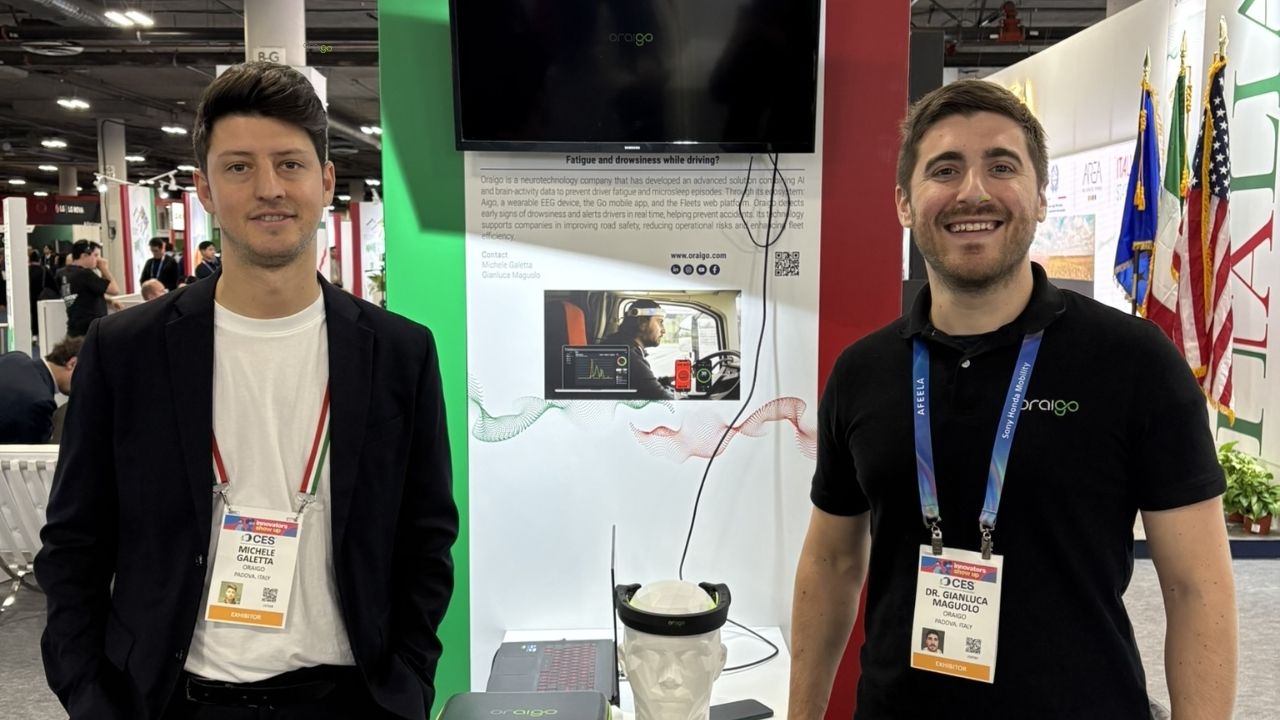
We were thrilled and honored to be able to participate in this year’s CES event! Oraigo’s participation in CES Las Vegas reflects the growing recognition that road safety innovation must address not only vehicles and infrastructure, but also the human behind the wheel.

As fatigue and reduced alertness continue to be major contributors to accidents, particularly in commercial and fleet operations, Oraigo brings a science-driven, preventive approach to one of the industry’s most persistent challenges.
At CES, Oraigo is showcasing its neurotechnology-based safety system designed to detect driver drowsiness in real time. Unlike traditional safety tools that rely on visual cues or driving behavior alone, Oraigo’s solution measures neurological signals to identify changes in alertness before performance visibly declines. This early detection enables timely alerts and interventions, helping drivers regain focus or take appropriate breaks before risk escalates.
Oraigo’s presence at CES is also an opportunity to demonstrate how neurotechnology integrates seamlessly into broader safety ecosystems. The system is designed to complement existing technologies such as telematics platforms, advanced driver assistance systems, and compliance tools. By adding cognitive-state data to these platforms, fleets gain a more complete understanding of risk, one that combines behavior, vehicle performance, and human readiness.
Beyond the technology itself, Oraigo’s participation highlights a commitment to human-centered safety. The solution is built to support drivers, not monitor them punitively. By providing clear feedback and real-time support, Oraigo helps foster safer driving habits while reinforcing trust between drivers and fleet managers. This approach aligns closely with the industry’s broader shift toward safety cultures that prioritize well-being alongside performance.
CES Las Vegas also provides Oraigo with a platform to engage with global stakeholders, from fleet operators and mobility providers to OEMs and insurers, who are actively seeking preventive safety solutions. These conversations are essential for refining the technology, validating use cases, and accelerating real-world deployment.
By bringing neurotechnology to the CES stage, Oraigo contributes to a broader dialogue about the future of road safety—one where understanding human alertness is not an afterthought, but a foundational element of safer, smarter mobility systems.
CES as a Meeting Point for Industry Collaboration
One of the defining strengths of CES Las Vegas is its ability to bring together diverse stakeholders from across the global mobility ecosystem. Beyond product launches and demonstrations, CES functions as a collaborative platform where startups, established enterprises, policymakers, and researchers converge to shape the future of technology-driven safety and transportation.
For emerging technology companies, CES offers direct access to decision-makers who influence adoption at scale. Fleet operators, automotive manufacturers, insurers, infrastructure providers, and regulatory bodies are all present, creating opportunities for meaningful dialogue around real-world challenges. These conversations often extend beyond individual products, focusing instead on shared goals such as reducing accidents, improving compliance, and enhancing driver well-being.
Collaboration at CES also plays a critical role in accelerating innovation. Many safety technologies require integration across systems, vehicle hardware, software platforms, data analytics, and human interfaces. CES enables cross-industry partnerships that help bridge these gaps, allowing solutions to evolve more quickly from pilot programs to scalable deployments. For safety-focused innovation, this collaborative environment is essential to building trust, interoperability, and industry alignment.
Another important aspect of CES collaboration is policy and standards engagement. As new technologies emerge, regulatory frameworks must adapt to ensure responsible use. CES provides a neutral ground for innovators and policymakers to discuss best practices, ethical considerations, and compliance requirements. This dialogue helps align technological advancement with public safety objectives and regulatory expectations.
Finally, CES serves as a catalyst for long-term relationships rather than one-off interactions. Many partnerships formed at the event continue well beyond the exhibition floor, leading to joint research initiatives, commercial pilots, and global rollouts. In the context of road safety, this sustained collaboration is particularly valuable, as meaningful impact often requires coordinated effort across multiple sectors.
By fostering connection, dialogue, and shared purpose, CES Las Vegas plays a pivotal role in turning safety innovation into real-world progress—ensuring that new technologies are not only advanced, but adopted, trusted, and effective.
The Future of Road Safety Beyond CES
While CES Las Vegas serves as a powerful launchpad for innovation, the true measure of its impact lies in what happens after the event. The technologies showcased at CES offer a glimpse into the future of road safety, one that is increasingly predictive, personalized, and human-centered. As these solutions move from exhibition floors to real-world deployment, they are reshaping how fleets and mobility providers think about risk prevention.
One of the most significant shifts is toward predictive and personalized safety models. Rather than applying uniform rules to all drivers and vehicles, future safety systems will adapt to individual risk profiles. By combining behavioral data, vehicle performance metrics, environmental factors, and cognitive insights, fleets can tailor interventions to specific drivers, routes, and conditions. This personalized approach not only improves safety outcomes but also enhances driver engagement and trust.
Another defining trend is the growing emphasis on continuous learning. Safety systems of the future will evolve dynamically, learning from every trip, near-miss, and intervention. AI-driven platforms will refine risk models over time, enabling more accurate predictions and more effective preventive actions. This creates a feedback loop where safety performance steadily improves rather than resetting after each incident.
Crucially, the future of road safety will be built on collaboration between humans and technology. Even as automation advances, drivers will remain central to commercial transportation. The most effective safety strategies will focus on supporting human performance—reducing cognitive load, managing fatigue, and improving situational awareness—rather than attempting to eliminate human involvement altogether.
Beyond CES, these innovations point toward a safer mobility ecosystem where accidents are not just reduced, but anticipated and avoided. Fleets that embrace this evolution early will be better positioned to meet regulatory demands, protect their workforce, and operate more resilient, responsible transportation systems in an increasingly complex world.
Why CES Las Vegas Marks a Turning Point for Safety Innovation
CES Las Vegas continues to define where technology is heading—but more importantly, it highlights how innovation must serve real-world needs. As mobility systems grow more complex, the message emerging from CES is clear: the future of transportation depends not only on smarter vehicles, but on safer, more human-centered solutions. Road safety is no longer a secondary consideration, it is a core requirement for sustainable progress.
The technologies showcased at CES signal a shift from reactive safety models toward predictive and preventive approaches. Artificial intelligence, connectivity, and automation are powerful tools, but their true impact is unlocked when they are combined with a deeper understanding of human behavior and cognitive state. This is where the next generation of safety innovation is taking shape.
Oraigo’s presence at CES reflects this turning point. By bringing neurotechnology into the mobility conversation, Oraigo demonstrates how measuring driver alertness in real time can address one of the most persistent and underestimated risks on the road: fatigue. This human-first approach aligns with the broader direction of the industry—supporting drivers, strengthening fleet safety, and preventing incidents before they occur.
As CES looks toward the future, it reinforces an essential truth: meaningful innovation is defined not just by what technology can do, but by how effectively it protects people. In that future, safety starts with understanding the human behind the wheel.